

This Airport Guide lays out the arrivals process – from quarantine to immigration to customs – at Ninoy Aquino International Airport’s Terminal 1.
Post last updated from first-hand experience : 02 Feb 2025 (based on a 02 Feb 2025 arrival)
Post last updated/reviewed using other information : 02 Feb 2025
NOTE: This article offers general guidance and is not intended to be a definitive resource. The facilities and procedures discussed here are subject to change without prior notice.
In this post, we’ll explore arrivals at Terminal 1 (T1) of Ninoy Aquino International Airport (common abbreviation: “NAIA” / IATA code: MNL) – the main airport serving Greater Manila in the Philippines.
If you’re departing from Terminal 1, refer to my Airport Guides covering departures landside (before outbound immigration) and departures airside (after outbound immigration).
For a broader overview of Terminal 1, click here.
To learn more about the airport as a whole, click here.
CONTENTS
- Intended audience
- Before you fly: Entry requirements and pre-flight preparations
- Step 1: Enjoy the view as you land
- Step 2: Disembark from the plane
- Step 3: Quarantine inspection
- Step 4: Immigration
- Step 5: Baggage reclaim and Customs
- Step 6: Leaving the terminal
- Appendix: Pandemic-related measures
INTENDED AUDIENCE
This guide was written from the perspective of, and primarily for, travellers who hold Philippine passports.
Foreign nationals, unaccompanied minors, and other travellers with special conditions are subject to more complex arrival requirements which I am unable to advise on out of first-hand experience. Having said that, much of the information set out below – such as the layout of MNL’s arrivals area and the general flow of entry procedures – will be of interest to all passengers regardless of circumstances.
BEFORE YOU FLY: ENTRY REQUIREMENTS AND PRE-FLIGHT PREPARATIONS
Please bear in mind that no visa-related advice is offered in this guide. Contact the Philippine Embassy or Consulate in your country and/or the relevant government agencies – such as the Bureau of Immigration and the Bureau of Quarantine – if you require information other than what’s presented below.
Summary of quarantine-related entry requirements
In 2023, the Philippine government scrapped all remaining pandemic-era testing and vaccination requirements.
Electronic Travel Declaration (eTravel)
All arriving passengers must register their personal and travel information on the Philippine government’s Electronic Travel Declaration (eTravel) website. The information collected here covers both immigration and customs, although only customs officials will directly scan your system-generated QR code at arrival. (Immigration officials have direct access to your registered data on their terminals and do not require a QR code.)
Registration is free of charge and requires no app to be installed. Note that you can only log your details within 72 hours before arrival.
WARNING: There are reports of fraudulent/misleading websites that charge fees for eTravel registrations. Ignore them – the eTravel service is completely free of charge. Make sure that the website address you are using is https://etravel.gov.ph/, which can be counter-checked against the links provided in official sources.

STEP 1: ENJOY THE VIEW AS YOU LAND
STEP 2: DISEMBARK FROM THE PLANE
Most of T1’s gates are grouped around its two hub-like concourses. If your aeroplane docks at one of these, you’ll step out of the aerobridge pier into the narrow corridor that runs along the edge of the concourse. (The holding area for departures is on the other side of the glass wall.)

Follow the corridor until you reach the broad passageway that runs towards immigration. If your flight docks at one of the side gates (2, 7, 9, or 15), the walk will be shorter as the aerobridge leads straight into this passageway. If the aircraft parks at gate 1 or 16, the walk will be shorter still as both are adjacent to the immigration area.


STEP 3: QUARANTINE INSPECTION
Approaching the end of the main corridor, you’ll observe a manned counter fitted with a thermal camera. This is meant to rapidly screen the temperature of all passengers walking past.
The toilets are located near the end of the passage, just a short distance from immigration. There’s also a small duty free store where arriving passengers can purchase customary homecoming gifts such as chocolates and liquor.

Right before reaching border control, you’ll pass the Transfer Desk where travellers with onward flights can seek assistance from airport staff. You can read more about transferring at MNL here.

STEP 4: IMMIGRATION
Separate counters are used for Filipino citizens and foreign nationals. When using a manned counter, simply present your passport to the duty officer for inspection. (Keep your boarding pass close to hand in case it’s asked for.) Absent any special circumstances, the whole process will take mere minutes.
By default, Philippine passport holders are directed to use a bank of automated e-gates on the left side of the immigration hall.
The following video (not by me!) explains how to use an e-gate to pass through border control.
As of 2024, the e-gates no longer issue arrival stickers for affixing to passports. Simply sail on through when the gates on the other side swing open.
STEP 5: BAGGAGE RECLAIM AND CUSTOMS
From border control, walk forwards into T1’s baggage hall.
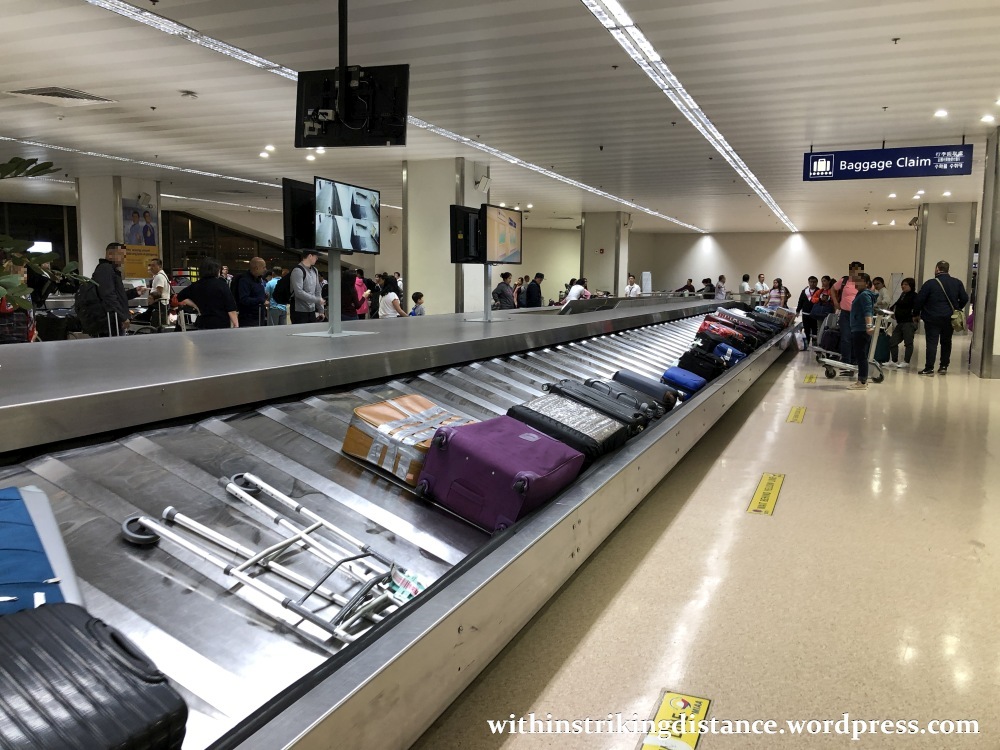
There are times when a flight’s assigned carousel isn’t immediately displayed on the screens in the baggage hall. Enquire with airport staff if this happens and they’ll direct you to the correct one.
As at other airports, there are separate customs lanes for passengers with or without anything to declare (red and green, respectively). This segregation is not always enforced and passengers are often funnelled through a single lane.
Bear in mind that all baggage is subject to inspection at the customs officers’ discretion, even if you pass through a green lane. This may involve an x-ray check and/or a hand search with follow-up questions as needed.
Have your eTravel QR code ready for scanning at the customs barrier – this takes the place of the paper cards that were previously used.
STEP 6: LEAVING THE TERMINAL
Beyond the customs barrier is T1’s arrivals hall. You’ll find a couple of cash points (ATMs), bureaux de change, and various other service booths, but no shops or cafés.

Unless you’ve arranged to meet someone in this hall, keep going straight and out through the doors. You’ll emerge into a sheltered roadway that runs alongside the terminal building.
Private vehicles can collect arriving passengers from the stopping points labelled A1-A10, where A8-A9 are reserved for persons with disabilities (PWDs). A11-A12 are for VIPs and A13-A14 are for hotel pick-ups.
Crossing the road to the parallel lane gets you to stopping points labelled B, which are also for private pick-ups. Towards the end of the island, you will find the designated pick-up point for vehicles hired through the ride sharing app Grab (as well as a booking desk for travellers without the app installed).
If you’re looking for a taxi, walk all the way to the other side using the zebra crossing in the middle. From there, you’ll descend by a broad ramp to the so-called arrivals extension: a sheltered waiting area near the front parking lot. This is the designated pick-up point for taxis serving T1.

You can read more about travelling from MNL to other parts of Greater Manila (and beyond) in my separate airport transportation guide.
APPENDIX: PANDEMIC-RELATED MEASURES
In 2023, the Philippine government scrapped its last remaining pandemic-era emergency directives. Public transport operates at full capacity and disease-control protocols – including mask wearing and social distancing – are no longer enforced.
Be aware that some establishments (such as healthcare facilities) might impose stricter requirements within their own premises and ask visitors to put on a mask before entering.
Like what you’re reading? Buy me a coffee!

 Within striking distance
Would you happen to know where is the transfer bus for passengers with connecting flights in Terminal 2? Also, are there cafes or lounge area inside the arrival area were one can wait (especially if the arrivals is early morning between midnight & 6 am). Just like what they have at Terminal 2 domestic, which is just near the baggage area before exit?
If I’m not mistaken, the PAL transfer buses stop right outside the arrivals lobby of T1 (turn right as you exit and walk towards the end of the covered road). Needless to say, locations may shift without notice so I’d recommend contacting the airline to obtain updated information.
This transfer guide published by PAL might come in handy:
Click to access transfer-guide_as-of-14nov23.pdf
“[A]re there cafes or lounge area inside the arrival area were one can wait” – none that I’m aware of, apart from the hotel-sponsored lounges across the road from the arrivals lobby (which are presumably exclusive to their own guests). You might consider taking a lift up from the arrivals lobby to the departures level above, where there’s at least a Jollibee fast food restaurant that could serve as a waiting spot.
Having said that, I’ve not personally tried moving up from arrivals to departures using the lifts in the lobby, so I don’t know if this is routinely permitted. The airport staff will be in a better position to advise – or you could try ringing the terminal hotline and ask.
https://www.miaa.gov.ph/index.php/about-miaa/miaa-directory/miaa-trunkline-terminals-1-2-and-4