As the global hub of Korean Air (KE), Seoul’s Incheon International Airport (ICN) connects South Korea to scores of destinations around the world. It also hosts special flights offering smooth links with two other Korean airports that don’t enjoy as many direct overseas connections.
In this post, we’ll learn how KE’s so-called transit exclusive domestic flights can help international travellers transit easily to or from Busan and Daegu.
What is a “transit exclusive domestic flight”?
A transit exclusive domestic flight (TEDF) is a special service operated by KE between ICN and either Busan-Gimhae International Airport (PUS) or Daegu International Airport (TAE) in South Korea. Even though these routes are technically domestic, TEDFs are handled as if they were international flights.
It’s worth noting here that ICN is designated for purely international use, with no domestic facilities whatsoever. TEDFs are a unique exception and solely because they are not treated as domestic.
In the hypothetical case of a traveller flying from an overseas airport to PUS via ICN:
- The overseas-to-ICN flight is a normal international service.
- The ICN-PUS flight is a TEDF and operated as if international.
- The traveller will NOT pass through immigration and customs at ICN, nor will they claim their checked luggage at ICN. In fact, they cannot leave the airside/transit area at all. For border control purposes, it’s as if the traveller has not yet entered Korea.
- The traveller will undergo border formalities (quarantine, immigration, customs) at PUS – marking their formal entry into Korea – and will also reclaim their checked luggage there.
Who can fly on a TEDF?
Only passengers connecting from/to an international flight at ICN can board a TEDF. The TEDF must be issued together with the international leg under a single ticket; it cannot be purchased or used separately. As mentioned earlier, ICN is a purely international airport and it is not possible to take a conventional domestic flight from/to there.
How does one book a TEDF?
TEDFs appear in search results, and can be booked in the course of a normal ticket purchase, on the KE official website.
The following example is based on a route search for travel between Cebu (in the Philippines) and Busan. Various time/transit combinations were presented, two of which are shown here. Note that GMP refers to Seoul-Gimpo International Airport, which handles all domestic air traffic for the Korean capital (excluding TEDFs) and is located a considerable distance away from ICN.
Option 1: CEB-ICN-PUS (with TEDF)

- KE616, CEB-ICN: International flight.
- Flight transfer: Airside transit within ICN. The traveller will not pass through immigration/customs and will not claim their checked luggage.
- KE1405, ICN-PUS: TEDF. The traveller will arrive at the international terminal of PUS (not the domestic terminal). They will pass through immigration/customs and will retrieve their checked luggage here.
Option 2: CEB-ICN-GMP-PUS (with domestic flight)
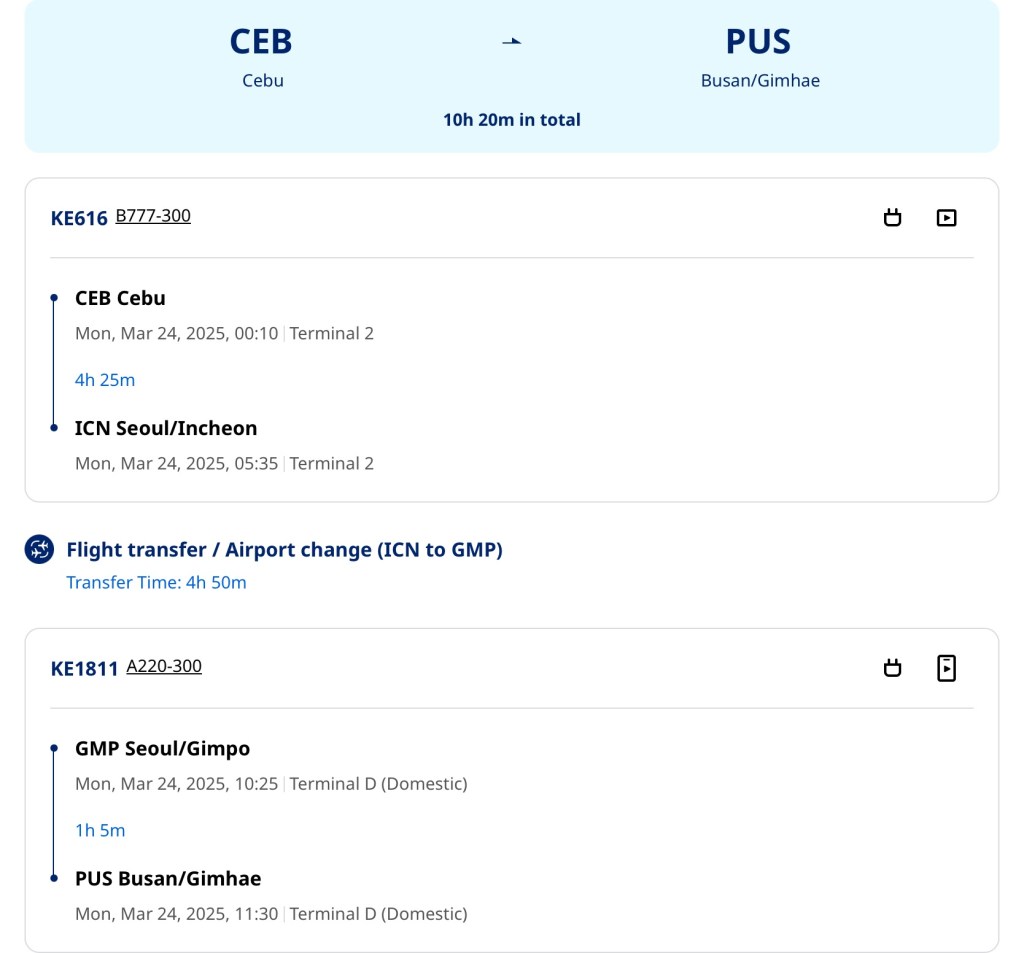
- KE616, CEB-ICN: International flight.
- Flight transfer: The traveller must pass through immigration/customs and collect checked luggage at ICN, then transfer on their own by train, bus, or taxi/car to the domestic terminal of GMP. Once there, they’ll need to re-check their luggage for the onward flight.
- KE1811: GMP-PUS: Normal domestic flight (not a TEDF). The traveller will arrive at the domestic terminal of PUS and will claim their checked luggage after arrival. They will not undergo immigration/customs formalities at PUS since these were already carried out at ICN.
REAL-WORLD EXAMPLE: Flying from Manila to Busan (via ICN) with a TEDF
The following case describes an actual journey I took on 27 January 2025. Note that transit facilities and procedures may change without prior notice.
KE do not fly directly between Manila’s Ninoy Aquino International Airport (MNL) and PUS. However, they do operate non-stop flights between MNL and ICN, from where a TEDF can be taken to complete the journey to PUS.
First leg: MNL-ICN (KE 626)
This was a normal international flight. Click here to read a detailed report about the experience.
Check-in and boarding procedures were essentially the same as for any overseas journey. At the MNL airport counter, I was issued two boarding passes (MNL-ICN and ICN-PUS) and my checked luggage was tagged for direct transfer to PUS. Just to be doubly certain, I reconfirmed with the check-in agent that TEDF rules applied to my itinerary. (I’d recommend doing the same to make sure that your boarding passes and luggage tags correctly reflect the special transfer.)
Transit: within ICN
The following information screen (taken in the transit area at ICN) summarises the whole flight transfer procedure.

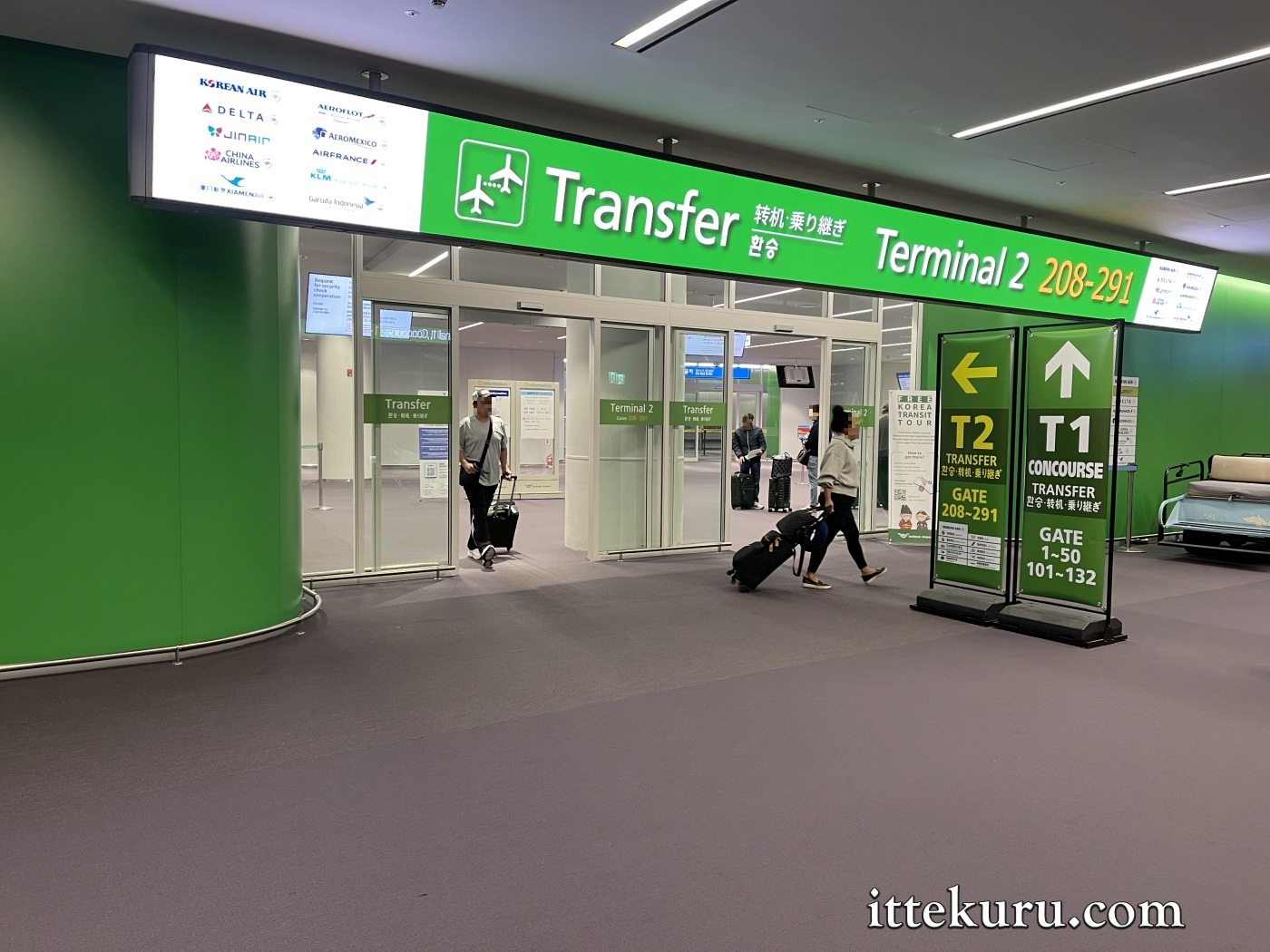
After landing, I followed the signs to the nearest “Transfer” zone (not the signs reading “Arrivals” which would have led me to immigration).

Through the doors and off to one side was a KE counter, where transiting passengers without their onward boarding passes can get these issued.

Since I already had my boarding pass for the next leg, I simply headed straight for the security turnstiles.
The turnstile screen asks passengers to prepare both their passport and boarding pass, but I was allowed through after scanning just my passport. (This might be because I’d already supplied my passport number when I booked my ticket, but that’s speculation.)

Directly after this was a standard airport security checkpoint.
Afterwards, I took an escalator up to the general departures area (where the boarding gates were located).
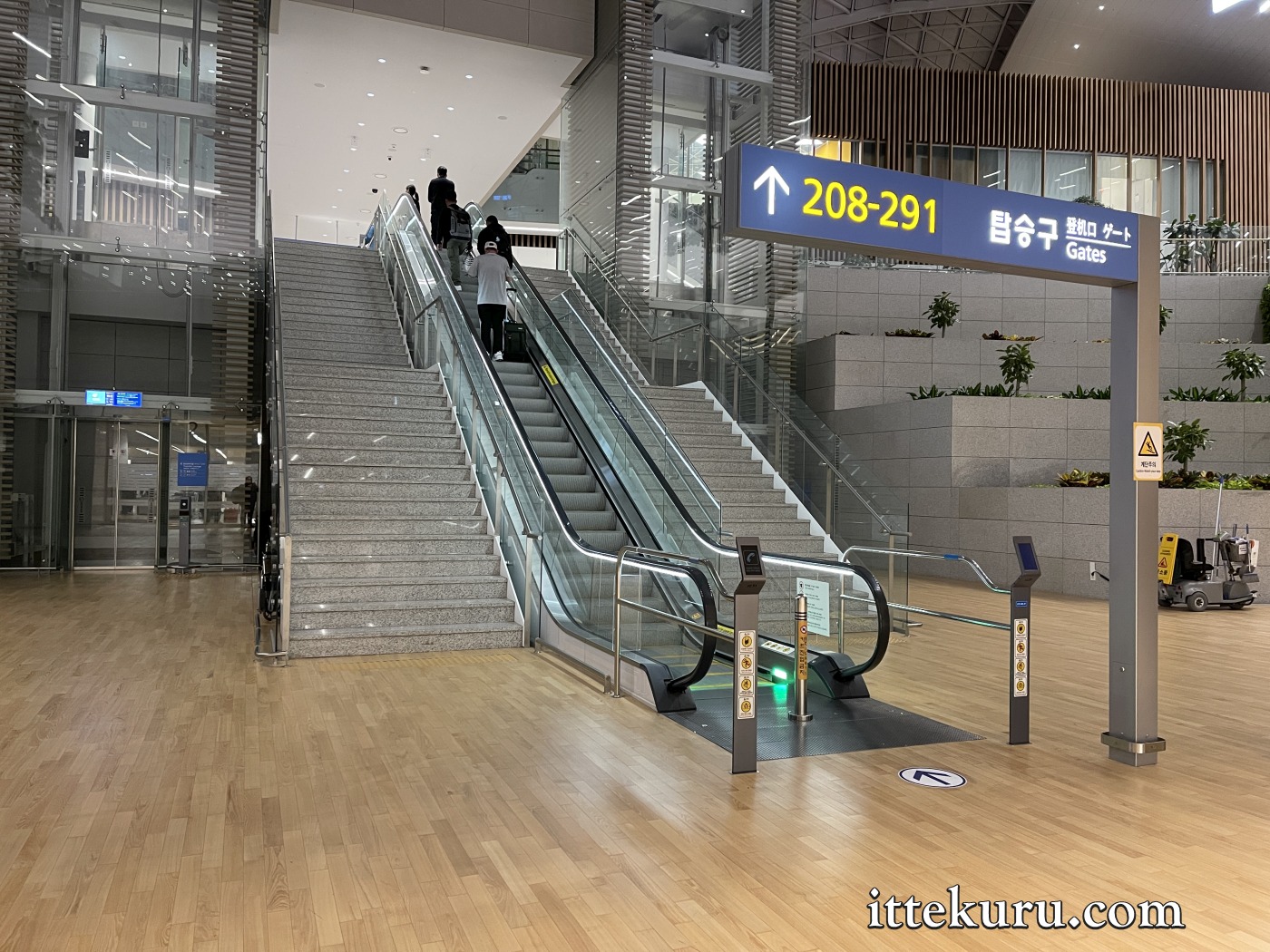
And that was that. From this point on, I was just another departing passenger waiting for his flight. No quarantine, immigration, or luggage reclaim here: those were all in store for my final stop at PUS.
There’s one important distinction to bear in mind, though: passengers transiting to TEDFs do not have duty free shopping privileges at ICN (easily enforced as boarding passes are scanned at tills). This makes sense as such passengers are on their way into Korea, not out of it; hence, any goods they purchase are being brought into the country and potentially subject to taxation. That said, one is perfectly able to dine or shop at non-duty free establishments like cafés, the food courts, and convenience stores (I have done so myself without issue). All other airside facilities, whether free or charged – e.g., the pay showers up in the transit lounges – are open for use as well.
Second leg: ICN-PUS (KE 1429)
This flight was a TEDF. Click here to read a detailed report about the experience.
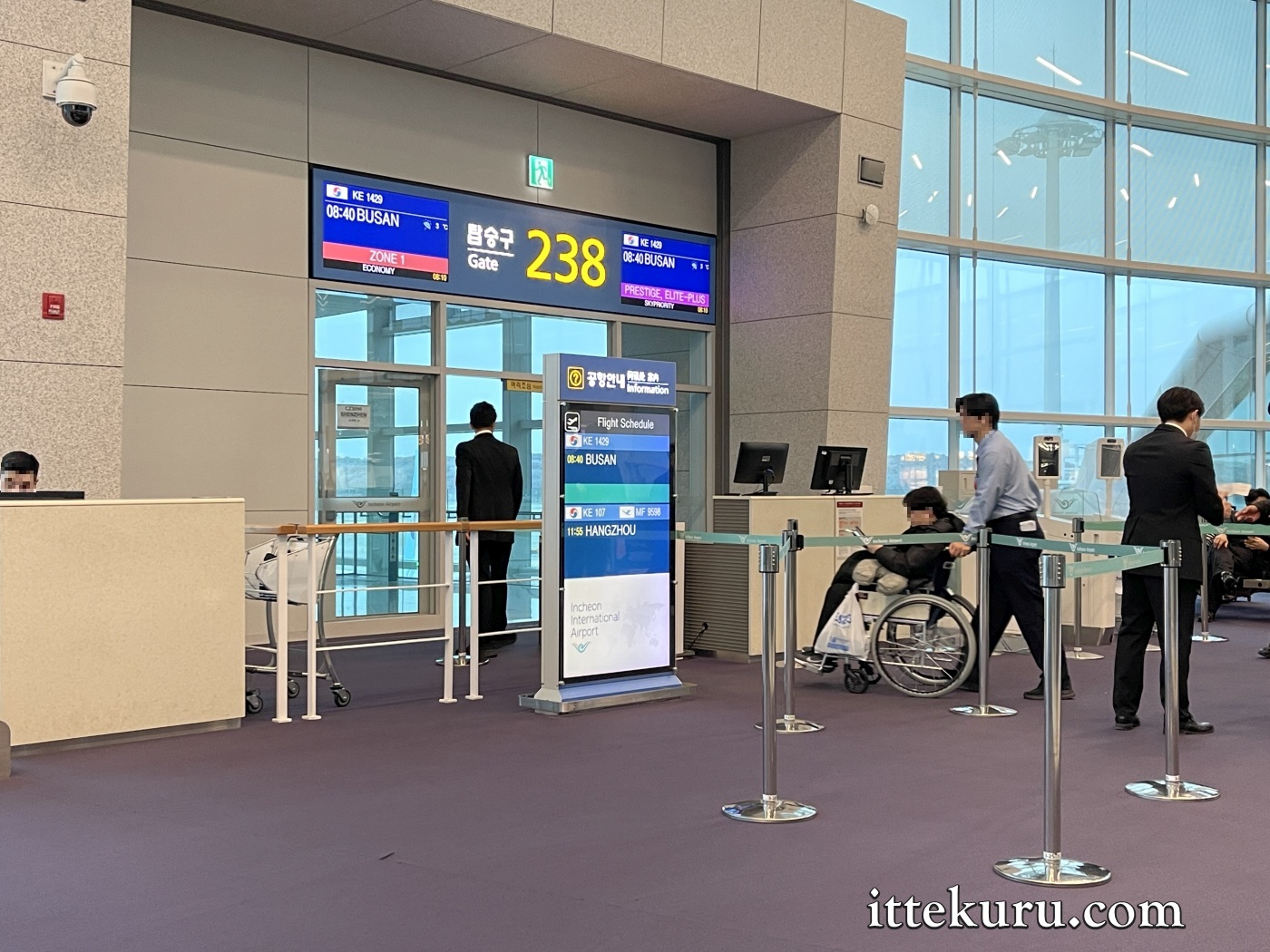
Embarkation followed the usual protocols: boarding card and passport inspection at the gate, muster by priority order and zone, etc.
During the flight, cabin attendants distributed blank immigration cards for foreign passport holders. This was in preparation for the border control procedures that awaited us at PUS.


Arrival: PUS
Since it was (operationally) not a domestic flight, KE 1429 docked at PUS’ international terminal.
The first barrier after landing was quarantine, which I sailed through thanks to the Q-CODE form I’d completed prior to departure. (Many other passengers were stuck filling out the electronic quarantine forms right then and there.)
Immigration followed, which entailed submitting my entry card and passport for inspection (as well as having my photograph and fingerprints digitally taken).
Next came baggage reclaim, which took a good long while – regrettably par for the course unless one is travelling with priority tags.
Finally, there was customs: easiest of the barriers by far as those without anything to declare could simply walk through the green lane and out to the arrivals lobby (no form required). Needless to say, the officers on duty were empowered to pull people aside for secondary inspection – whether randomly or based on evidence – but this did not happen in my case.
Cheers and happy travels.
Like what you’re reading? Buy me a coffee!

 Within striking distance
2 thoughts on “Korean Air’s Transit Exclusive Domestic Flights”