
In this post, we’ll hop aboard an overnight service that carries passengers on a 500-mile journey across Japan – all whilst they’re sleeping soundly in bed. (Or as soundly as they can manage on a moving train, anyway!)
Welcome aboard the Sunrise Seto.
Overview
Country : Japan
Railway company : JR Central / JR West (joint long-distance operation)
Service name/designation : Sunrise Seto (サンライズ瀬戸)
Service type : Limited Express, Overnight Sleeper
Rolling stock : 285 series EMU
Room type : Single
Date of journey : 28-29 September 2023
Origin : Tōkyō Station (dep. 21:50)
Destination : Takamatsu Station (arr. 07:27 +1)
Journey time : 9 hours 37 minutes
Ticket price : Base fare 11,650 yen, covered by my Japan Rail Pass. Additional cost 10,800 yen (3,100 limited express surcharge + 7,700 accommodation fee), paid upon booking.
Route map
Google Maps generates different results for each retrieval, so the track shown below won’t necessarily reflect the train’s actual route. That said, it’s a good approximation of the direction and distance involved.
Booking my room
I secured a berth on the Sunrise Seto through JR West’s official website. Because this train often sees heavy demand, I firmed up my arrangements about a month ahead of my intended date of travel. (Note: The system won’t accept reservations more than a month in advance.)
During the reservation process, I was given the option to purchase a base fare ticket (the cost of which varies by distance travelled). For this route, the base fare amounted to 11,650 yen. Since my JR Pass would fill the role, I elected not to add a base fare ticket to my booking.
But there was no avoiding two other fees. The Sunrise Seto is classed as a limited express service, meaning that to ride it I was also on the hook for a limited express surcharge of 3,100 yen (also dependent on distance). A JR Pass typically covers the base fare and the surcharge for trains it’s valid on, and if I’d chosen the ultra-basic nobi nobi seat this would have been the case for the Sunrise Seto. However, the JR Pass will not cover the surcharge for any kind of private room.
The final component was the accommodation charge of 7,700 yen for the Single room I’d selected. The price depends on the type of berth, from zero for a nobi nobi seat to more than 15,000 yen for a double-occupancy twin room.
All told, I paid 10,800 yen for my no-base-fare ticket. (Absent a JR Pass, I would have had to pay 22,450 yen including base fare.) I received a reservation number that I later presented – along with the credit card used for the booking – at a JR counter in Tōkyō to claim the actual ticket. This last step is necessary as one cannot travel on the Sunrise Seto with a reservation alone, even if fully paid for.
The journey begins
Outbound trips of the Sunrise Seto depart from Tōkyō Station.
A major hub catering to long-distance travellers, Tōkyō Station is crammed with shops selling all manner of prepared food and beverages. Since the only retail presence aboard tonight’s train is a vending machine – and a rather sparsely stocked one at that – passengers would do well to purchase provisions at the station prior to departure.
I bought food for two meals (dinner plus breakfast), then walked to Platform 9 and settled in for a long wait near my assigned car’s boarding point.
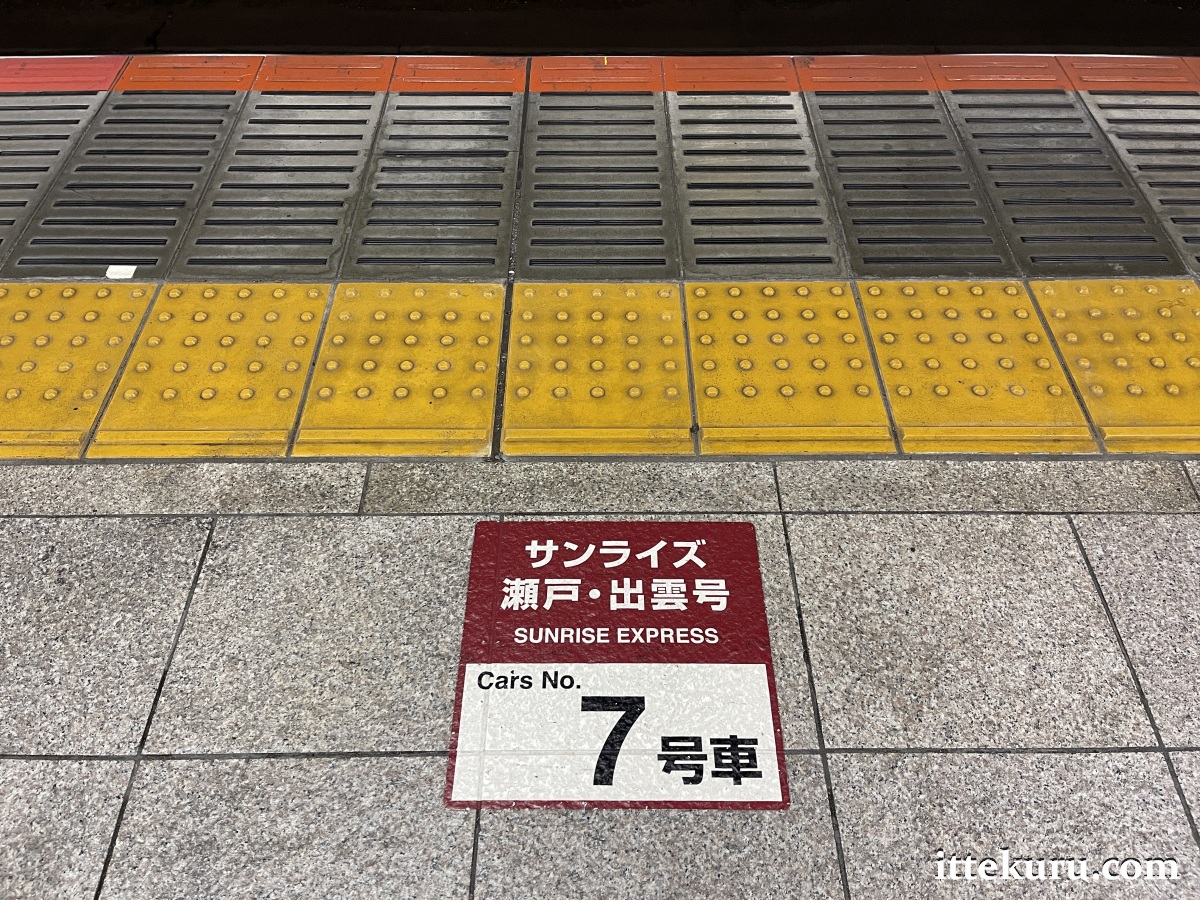

Later that evening, the Sunrise Seto – coupled to its sister service the Sunrise Izumo as a single long train – pulled into the station and parked alongside the platform.


On every run, each of the two services uses a 285 series EMU 7-car train set, with two sets coupled together into a single 14-car train at Tōkyō Station. The combined train travels as far as Okayama, where the two halves separate and proceed to their respective final stops. The Seto heads southeast towards Takamatsu (on the island of Shikoku), whilst the Izumo stays on Honshū and marches northwest towards its namesake destination.
Right, let’s get ourselves on board.
My room on the train
The Sunrise Seto is fitted with several different kinds of berth, from spartan nobi nobi seats (which aren’t even seats to begin with) all the way up to posh Single Deluxe rooms. I won’t go into detail regarding each class of accommodation here; instead, I direct the readership to this comprehensive entry on JPRail where every room type is described.
I’ll also supply another link, this one leading to a blog post of mine describing a 2015 journey on the Sunrise Izumo in a top-tier Single Deluxe room. The ones on the Sunrise Seto are identical in features and appearance.
For the present, let’s concern ourselves with the type I actually booked: the aptly-named Single.
Car 7 is a bi-level vehicle with nine Singles on the upper floor, nine of the same type on the lower floor, and a so-called Single Twin positioned mid-level at either end. (Please refer to the JPRail post linked above for details about each room category.)

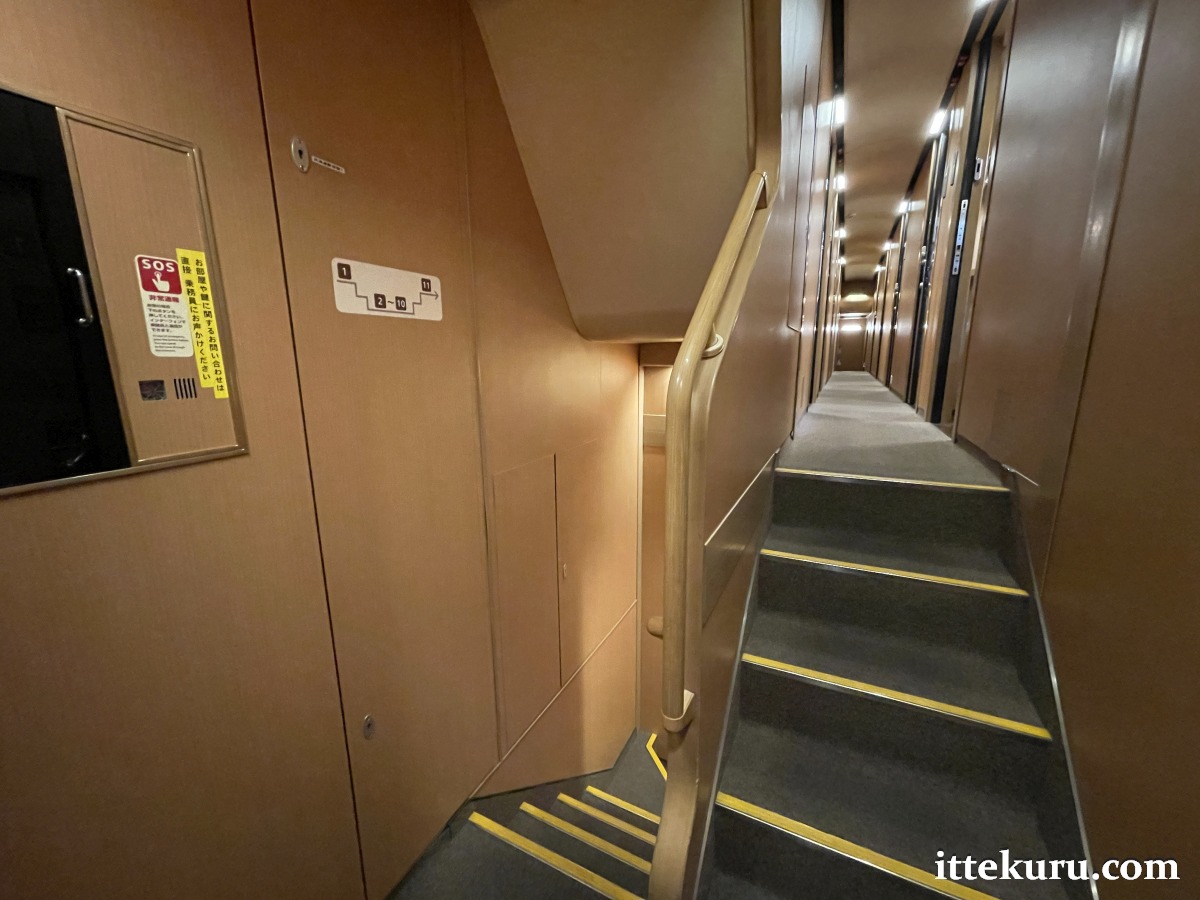
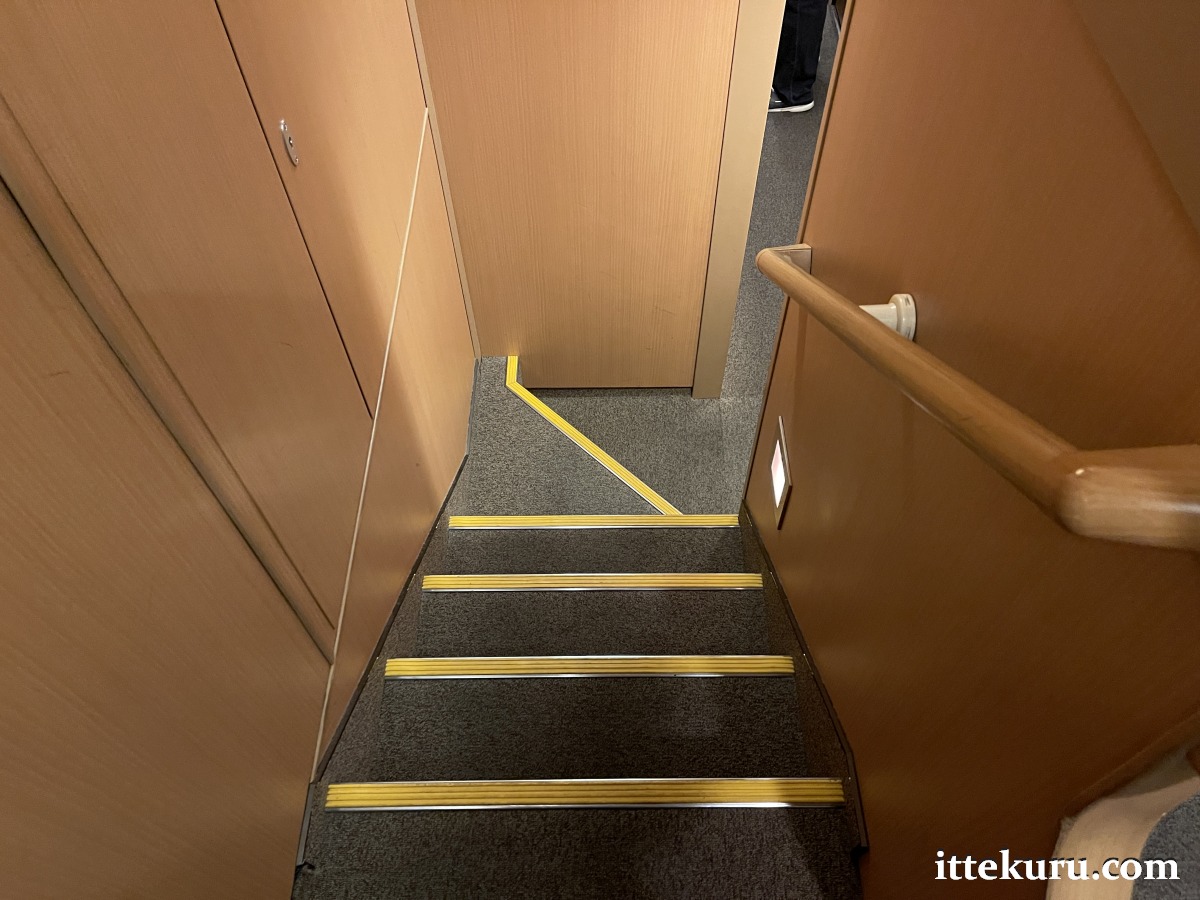
The reservation system won’t let you choose a specific room, only a room type. Had I been given the option, I’d have selected a berth on the upper level (mainly for the better view). Alas, I was assigned to Number 2 down in the depths of Car 7.
The door is initially unlocked and slid open, but you can secure it from outside by entering a four-digit code of your own choosing. A mechanical lock is fitted on the other side to pin the door shut from within.
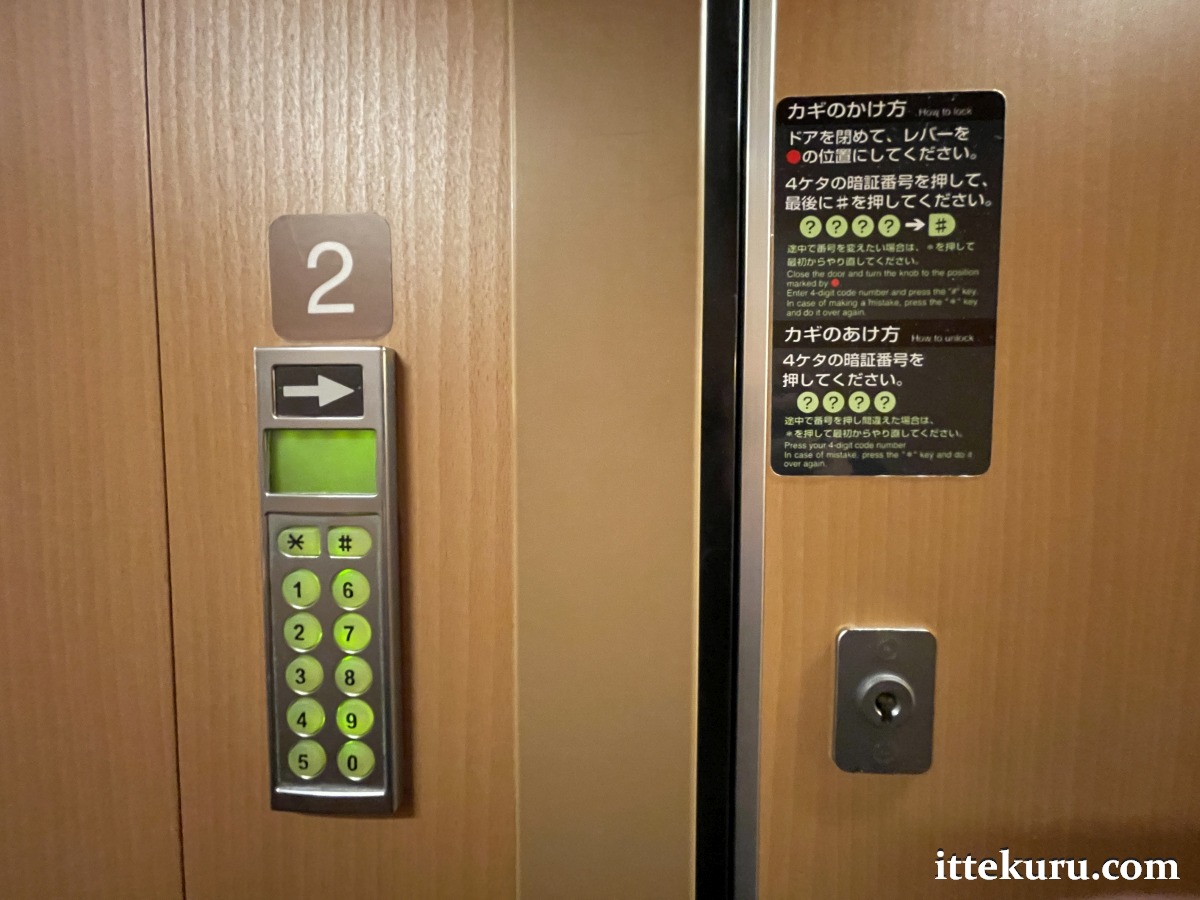
Now for a peek inside.
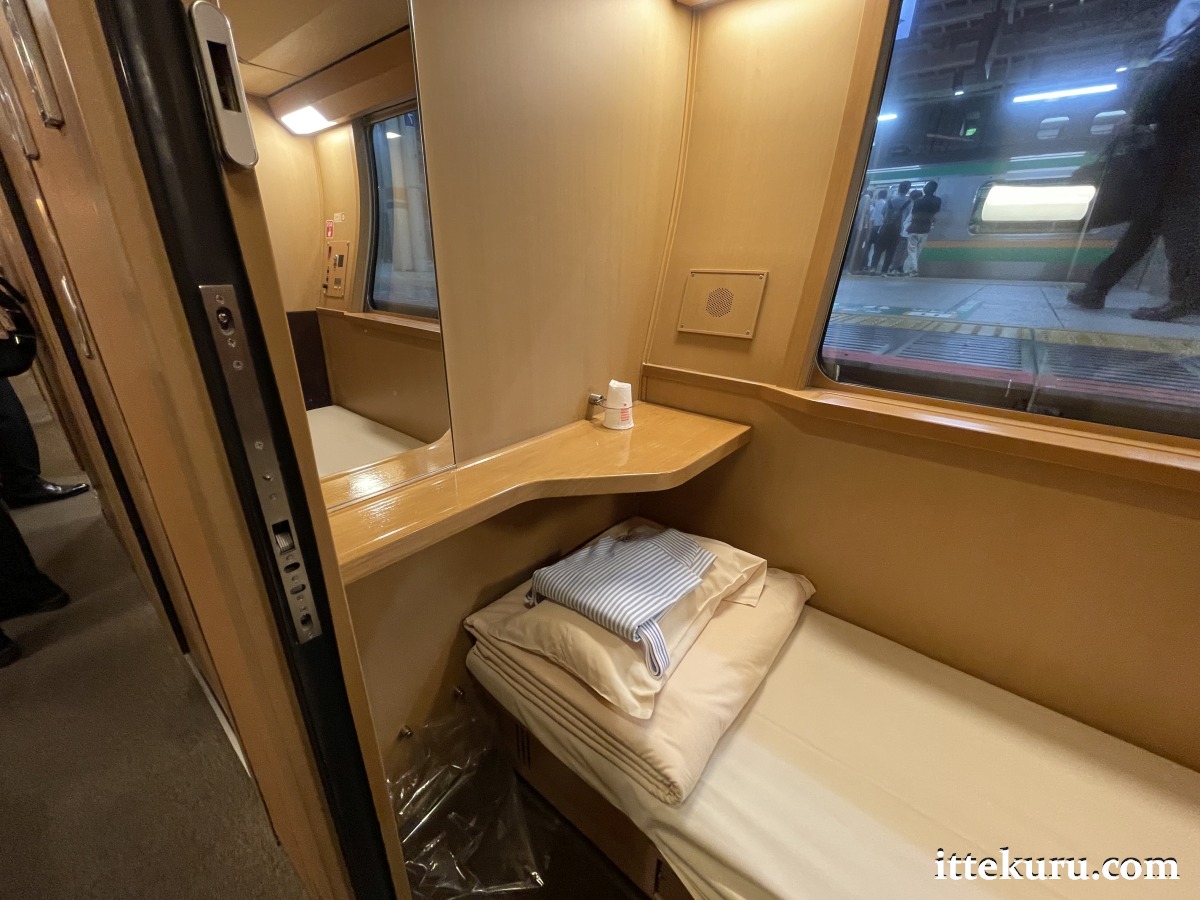
An extremely compact space, but it has all the essentials and then some.

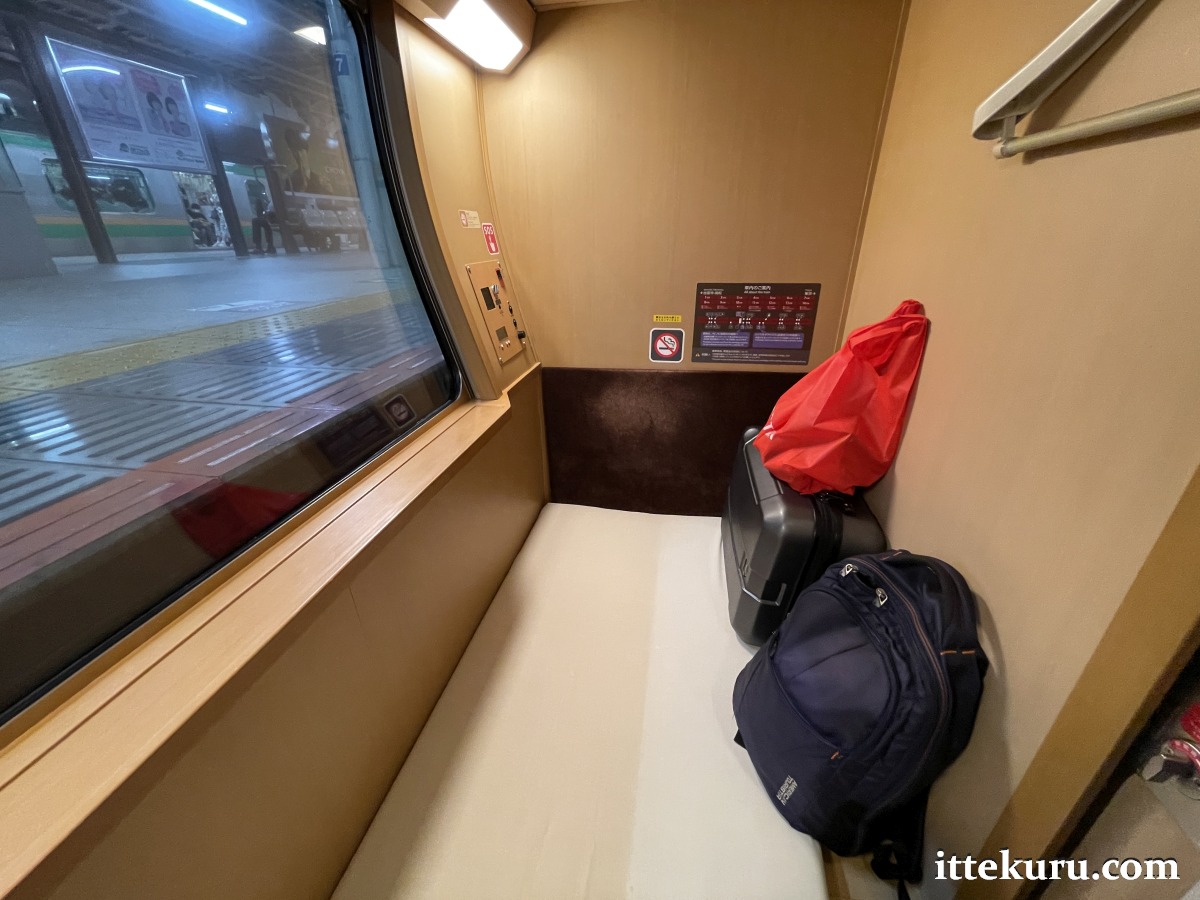
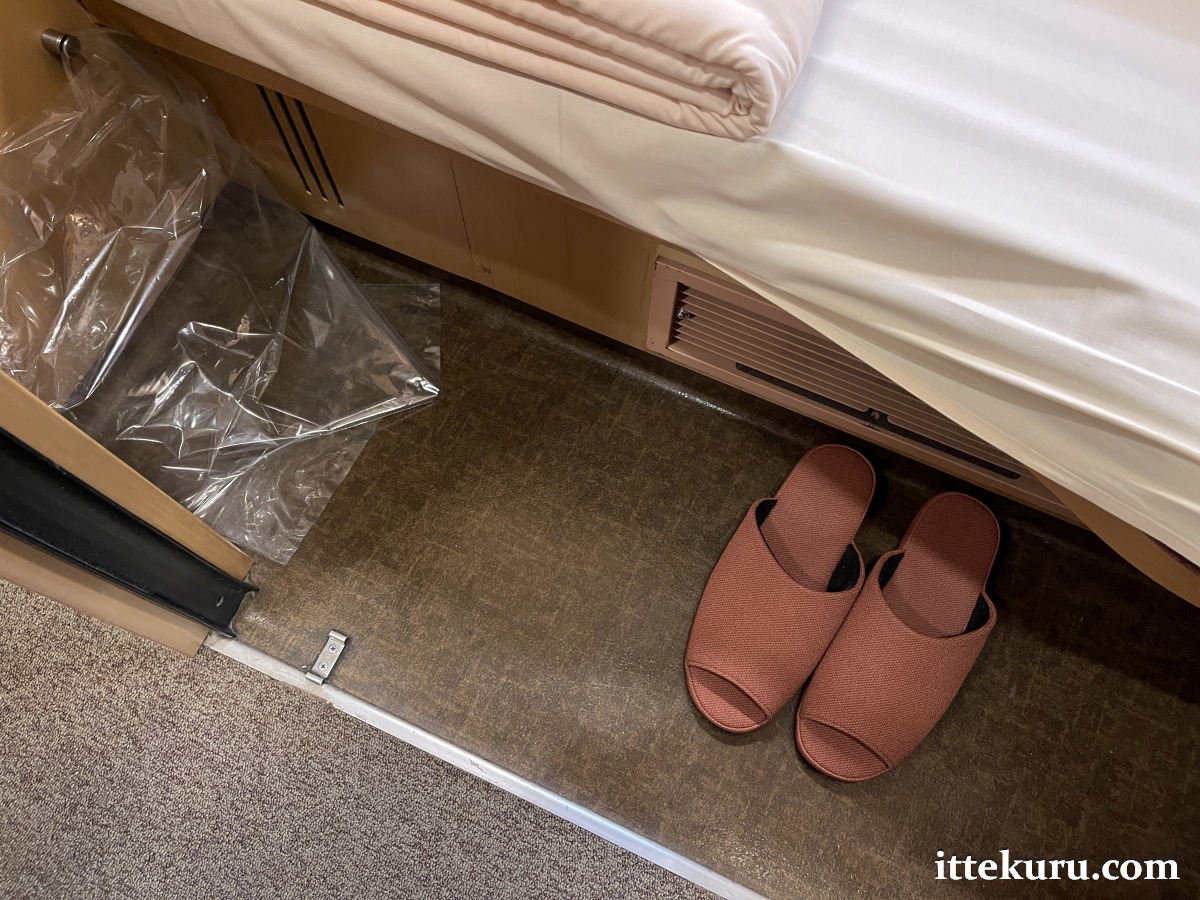
Note the narrow shelf for baggage between the bed and the wall. (For reference, the hard-shell roller case visible in the picture is carryon-sized.) Forget about bringing large suitcases aboard – use Japan’s reliable luggage forwarding services instead.
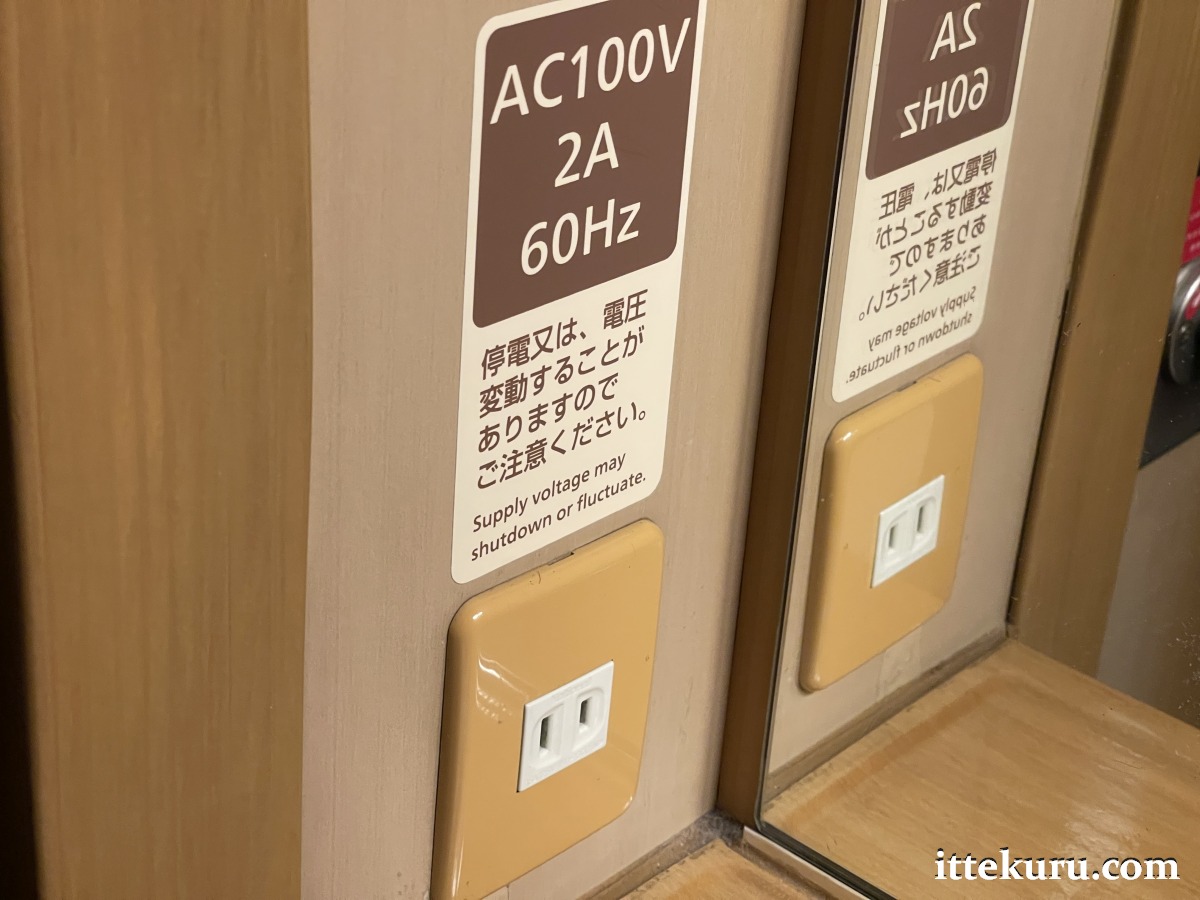
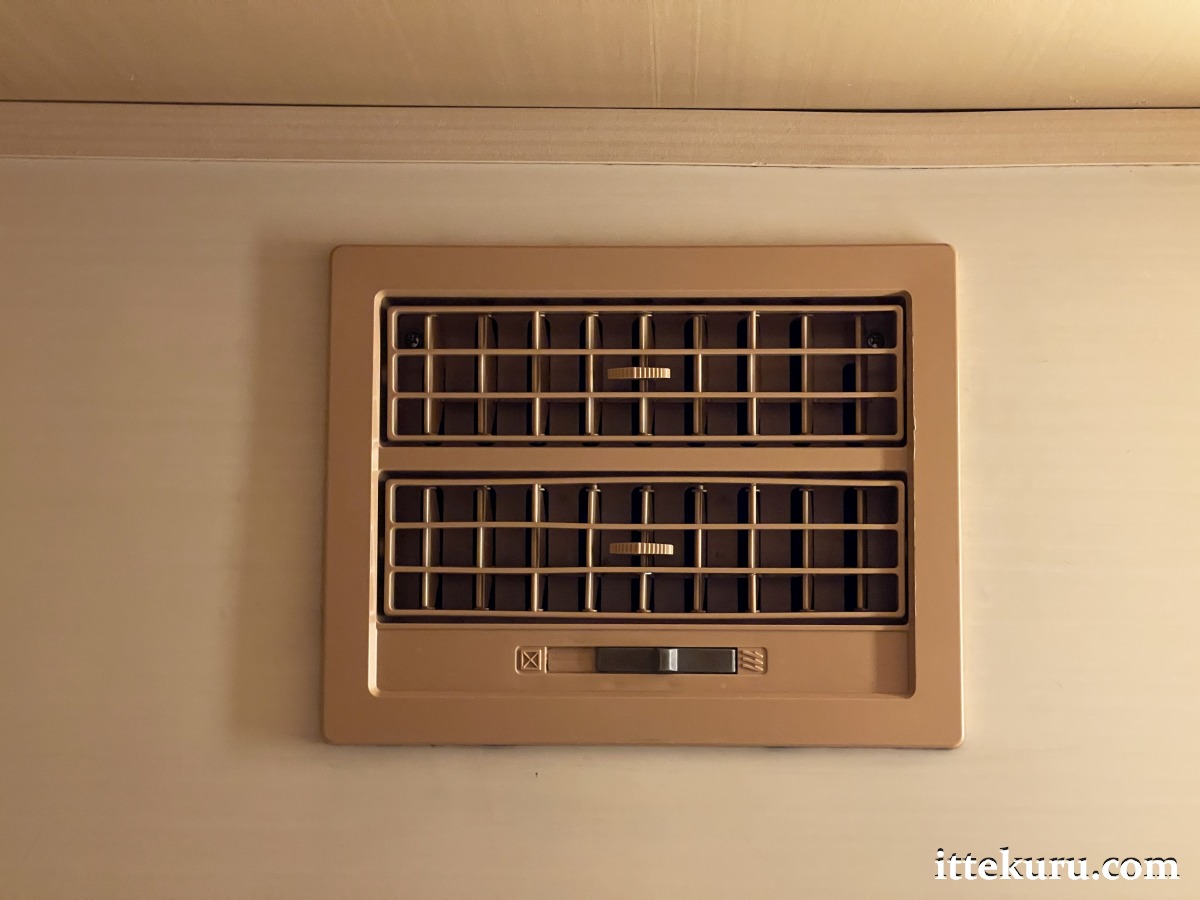
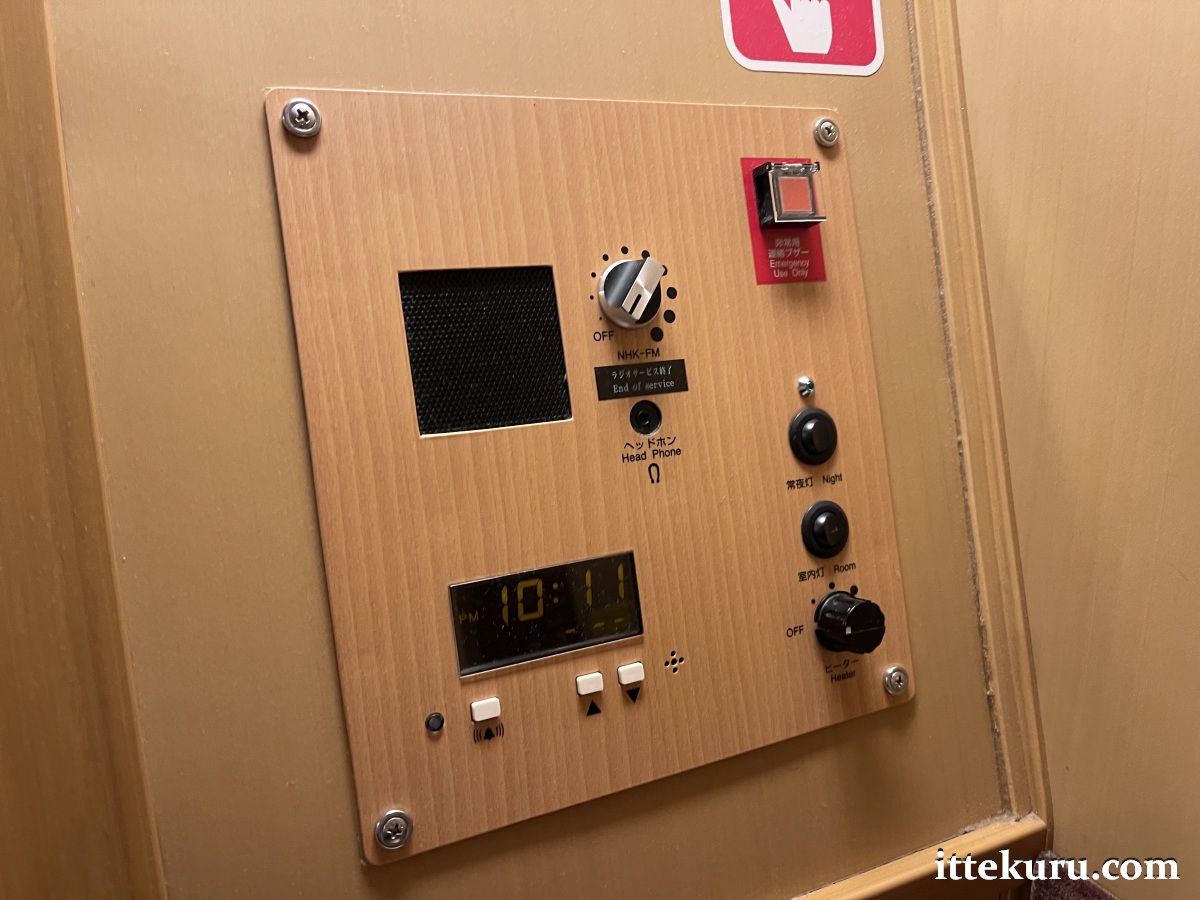
The room has a power outlet (100V), light switches, an alarm clock, and a louvered air vent.
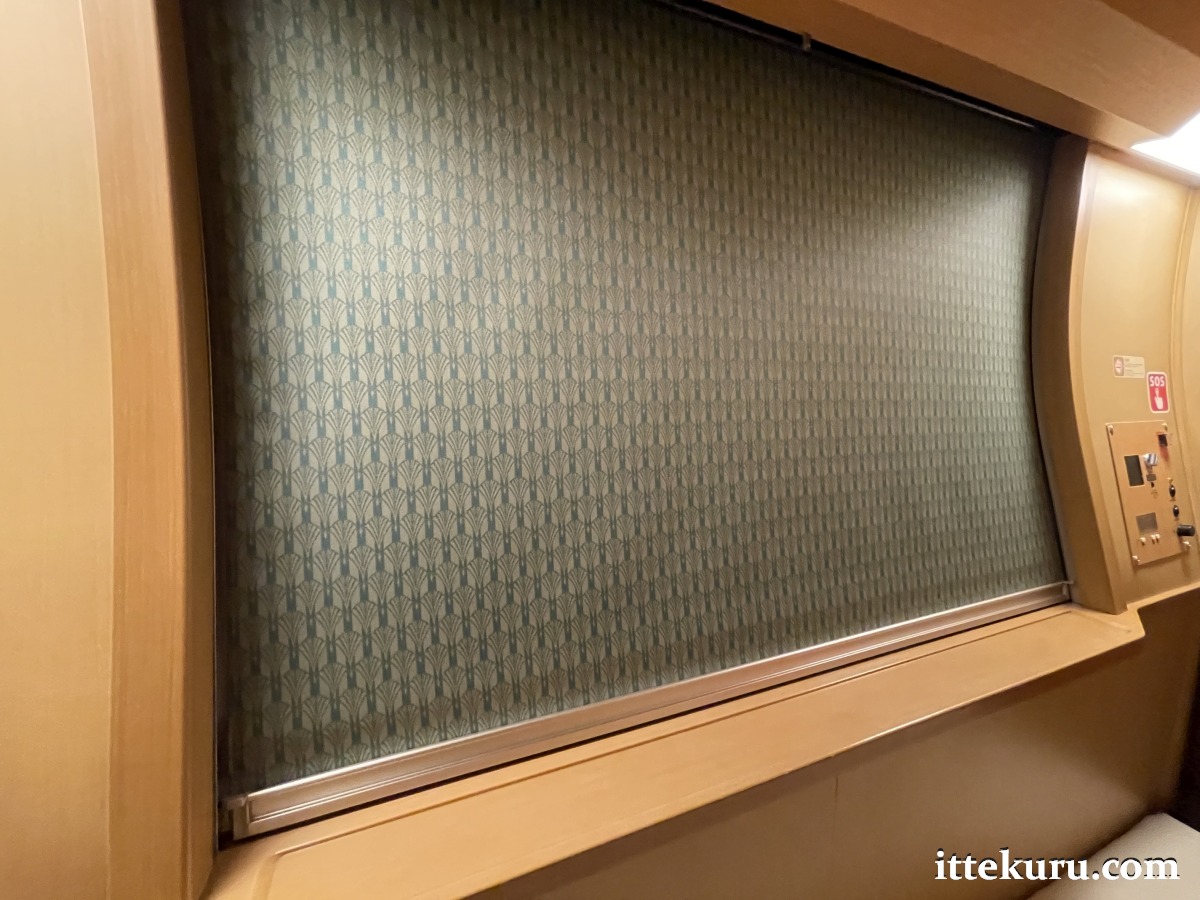
The outer wall and window follow the curvature of the compartment’s body. Here in this “basement” berth, the space is widest at the ceiling and narrows down by the bed and floor (the reverse is true for rooms on the upper floor). The window is fitted with a pull-down shade for privacy and to block out light from outside.

Onboard facilities
Here’s a simplified floor plan of the train posted in my room.
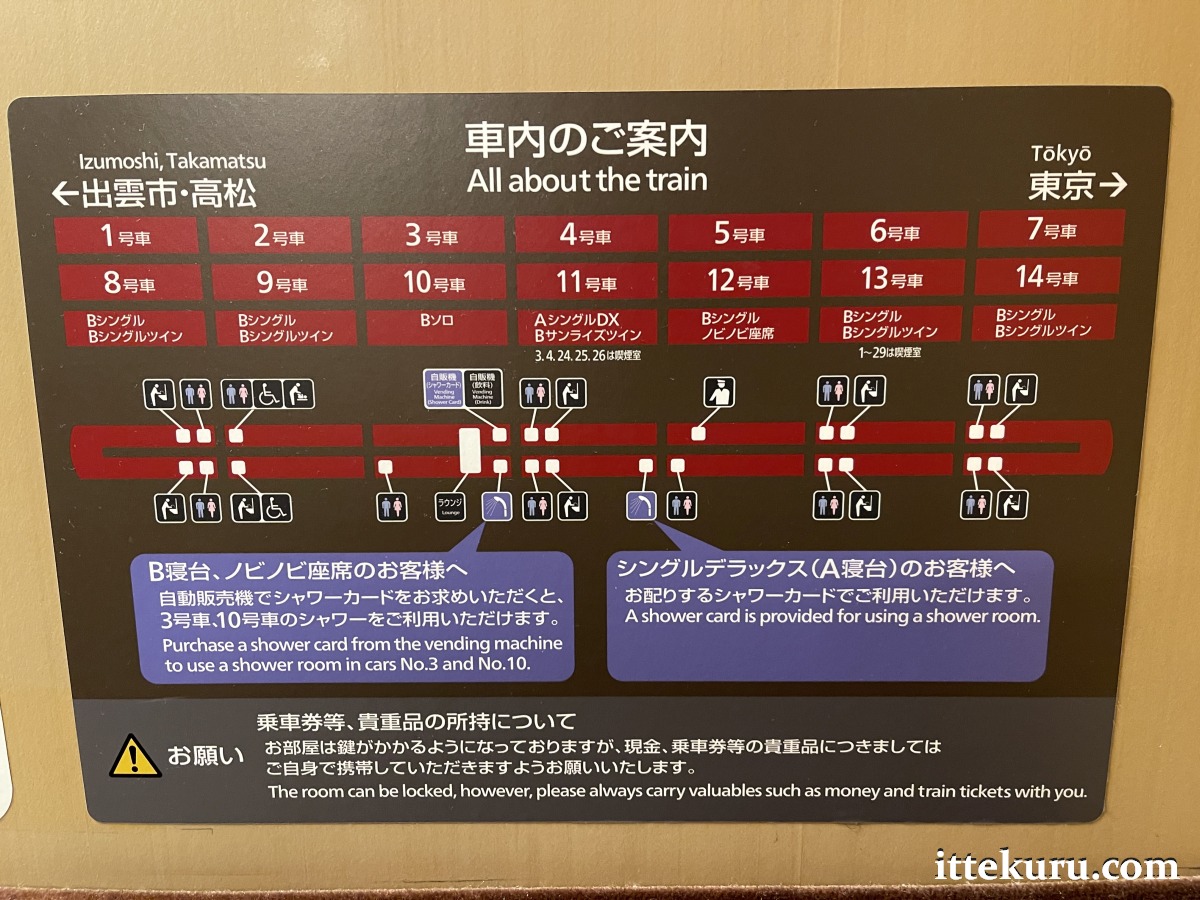
Every car is fitted with at least one toilet, and most of these have separate washbasins installed nearby.
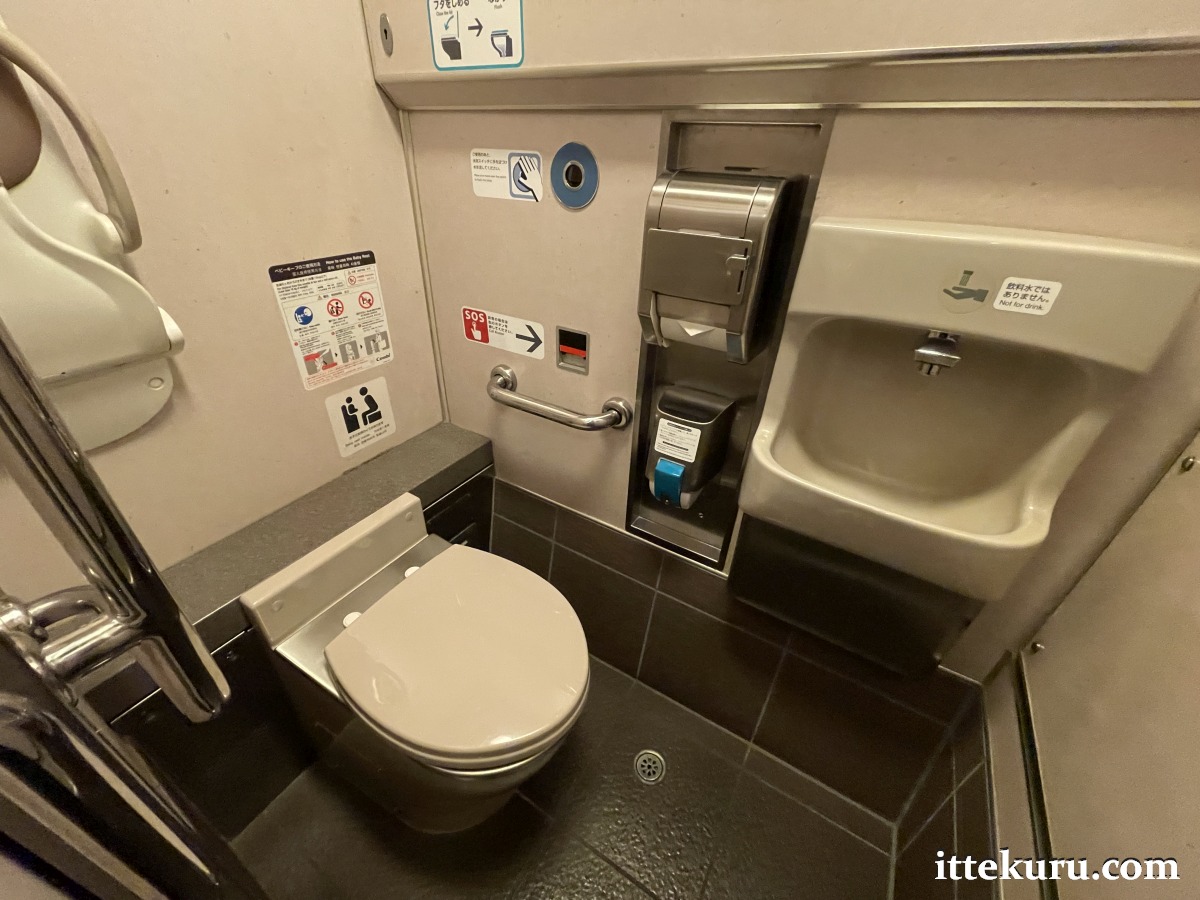
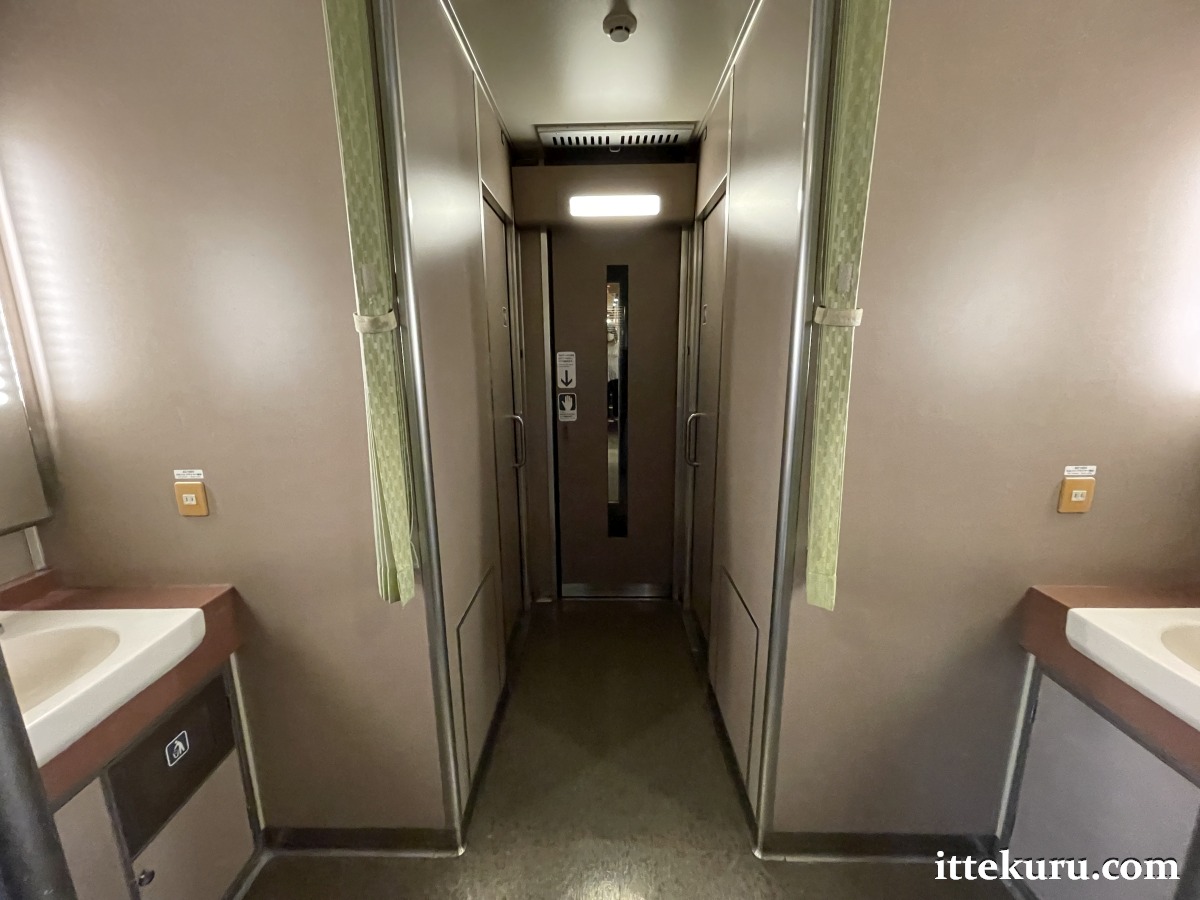
The main shared facilities are in Car 3/10 (note: which number is relevant to you depends on whether you’re aboard the Sunrise Seto or the Sunrise Izumo). Here you’ll find a lounge space and the only drinks vending machine in either half of the train.

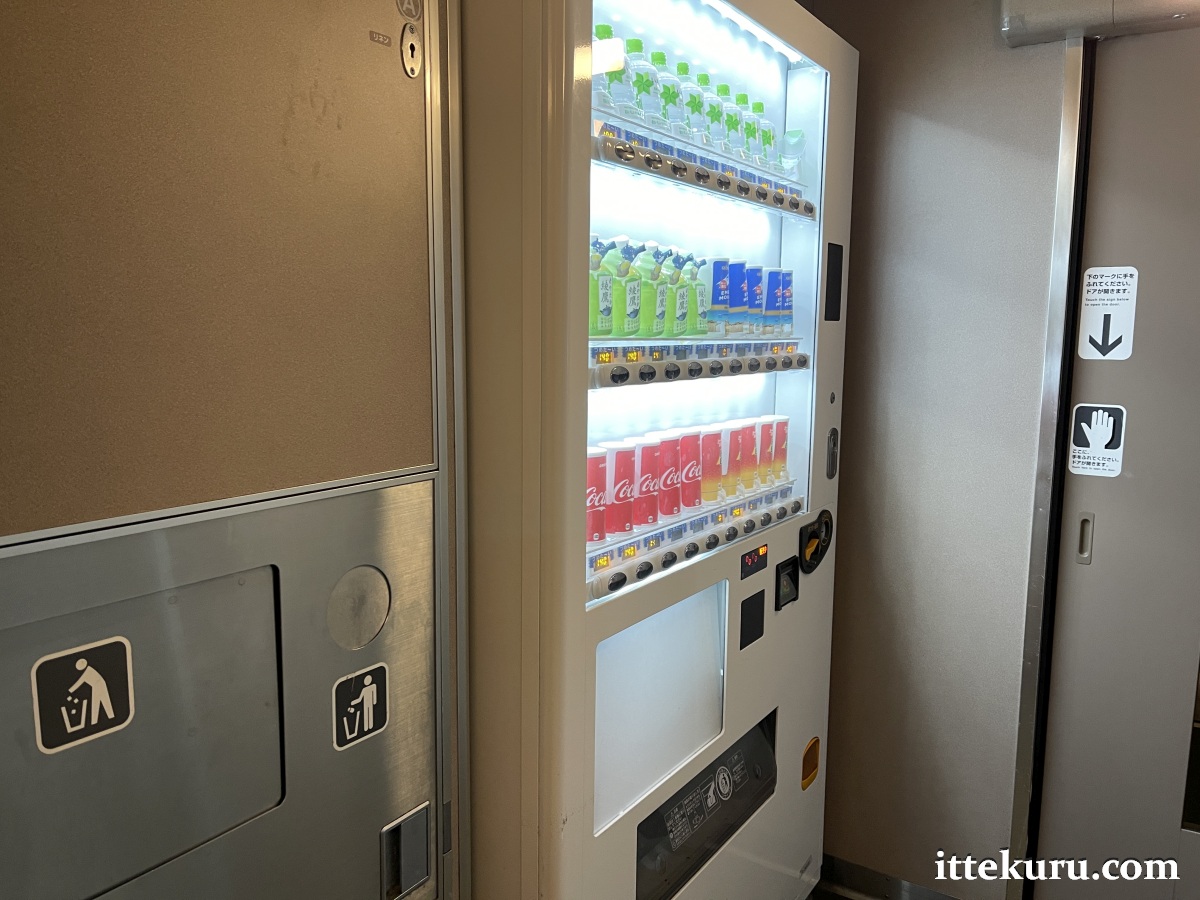
You’ll also find a small coin-operated vendor that dispenses timed-use cards for the nearby shared shower. Only a few cards are sold on each journey due to the train’s limited water supply.

There’s another shower in Car 4/11, but that’s for the exclusive use of Single Deluxe passengers who receive a complimentary card in their amenity kits. Pictures of that booth (which I expect is similar if not identical to the shared facility in Car 3/10) are available in my earlier post featuring the Sunrise Izumo.
One more thing: the corridors are very narrow indeed. Whilst traversing the length of the train in order to reach the lounge from my room, I found it easier to duck into vestibules and side doorways whenever I encountered people moving in the opposite direction (rather than attempt to squeeze past them).

The experience
Compared with the posh cruise trains operated by various JR companies (such as the legendary Seven Stars in Kyūshū), the Sunrise Seto is less of a hotel and more of a bare-bones hostel on wheels. To describe this service as a “luxury” experience is plain exaggeration. There’s no buffet car, no ensuite facilities (not even for Single Deluxe rooms), no televisions, no room service or anything of the kind.
For all that, if one’s expectations are managed, the two Sunrise Express services offer quite the unique and memorable way of travelling across Japan.
Shortly after getting underway, a conductor knocked on my door for routine ticket inspection. I presented both my JR Pass (as proof of base fare) and supplementary ticket (covering the express surcharge and accommodation fee), the latter of which he stamped before moving on to the next room.
Announcements for each embarkation stop are supplied over the PA system before ceasing mid-journey (since no further stops will be made until morning). The speakers will crackle back to life the following day when the train begins to call at stations – starting with Himeji – to let passengers off.
After changing into nightclothes and enjoying a store-bought dinner, I spread out the duvet in preparation for sleep. How much of it you’ll get depends on personal tolerance for noise and movement, since there’s no avoiding either. Unlike the silent and smooth rides one might experience on the high-speed Shinkansen, a night spent on the Sunrise Seto will inevitably come with chugging, clanking, the sensation of being pulled towards one side or the other…you get the idea. All of this is moderated by the vehicle’s suspension mechanisms and insulated walls, but not to the point of elimination.
In the end, did I get a good night’s rest? Not entirely, though it was a step up from my first sleeper train experience in Japan. Back then I only managed about three or four hours of sleep; this time, with an improvised extra pillow fashioned out of clothes and more comfortable nightwear, I think I managed a bit more. I should add that I was feeling under the weather during this journey, and had I been in tip-top shape my sleep quality would likely have been better.
Looking back and ahead
Time to dust off the scales of justice and render judgement on this whole experience.
On the one hand:
- This wasn’t the cheapest method of travelling from Tōkyō to Takamatsu. Had I taken normal, non-sleeper daytime trains, my JR Pass would have fully covered the journey with no extra fees involved.
- This wasn’t the fastest means of transport for the route. A combination of Shinkansen and conventional services (with just one transfer at Okayama) would have saved me about 3 hours.
- This wasn’t the most comfortable way to spend the night. Cramped space, single pillow, the creaks and motion of train travel and all the rest.
And on the other hand:
- I saved the cost of a night’s hotel stay. This partly offsets the accommodation surcharge, and even represents a net saving if I’d have stayed at a relatively expensive hotel that night.
- I was left with more daylight hours for sightseeing. By taking an overnight journey, I turned an otherwise idle evening (when I’d normally just be sleeping anyway) into a productive period of transporting myself from point A to point B.
- It was fun! My own bed on a train, bearing me away to a city hundreds of miles from where I began? Now that makes for a better travel tale than a boring daytime commute.
Would I do this again? Gladly, though perhaps not anytime soon. Concerns over cost, time, and comfort aside, the Sunrise Seto and Izumo are only practical options when I’m visiting a destination they serve (i.e., Takamatsu and Izumo-shi or the areas around them). Unless I’m heading for those specific parts of Japan, I’d be better off taking more conventional means of transport such as daytime trains or domestic flights.
Now for the “looking ahead” bit: I rode on the Sunrise Seto again a short while later, this time on the return journey from Takamatsu to Tōkyō. I’ll drop a link to that Rail Report once it’s online.
Until then, cheerio.
Like what you’re reading? Buy me a coffee!

 Within striking distance