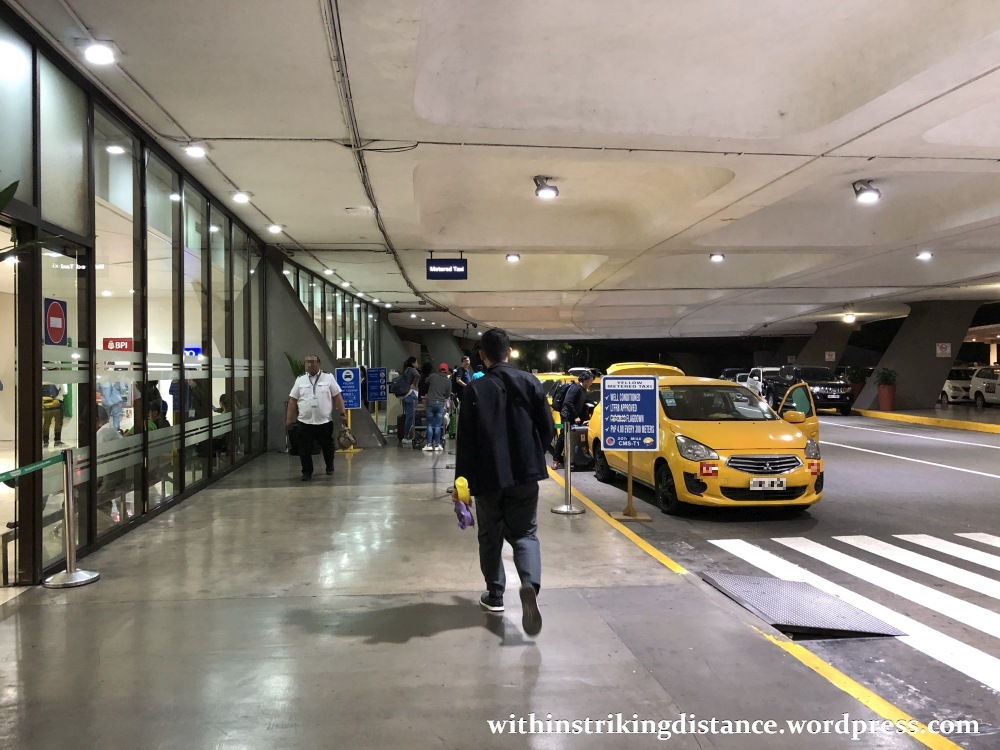

This Airport Guide sets out your options for travelling to and from Greater Manila’s Ninoy Aquino International Airport (MNL) – commonly referred to as NAIA – by road-based transport.
NOTE: Please use the information presented here with caution. Timetables, fares, routes and other details may change at any moment without prior notice.
Throughout this post, Ninoy Aquino International Airport will be referred to by its IATA code (MNL), rather than by its full name or its common abbreviation “NAIA”. The airport’s terminals will also be referred to in abbreviated fashion – e.g., “T3” for “Terminal 3”.
CONTENTS
- Alternatives (by rail, on foot)
- Access
- Private Transportation and Parking
- Public Transportation and Hired Vehicles
- Pandemic-Related Measures
Alternatives
Read about the other options for travelling to/from MNL in the following guides:
- Travelling by rail – MNL isn’t served by trains, but indirect access is possible via Manila’s urban rail network. This mode of travel is not recommended due to baggage restrictions on trains and frequent overcrowding (amongst other drawbacks).
- Travelling on foot – Not practical unless you’re using Terminal 3 (T3), which is equipped with a sheltered pedestrian bridge leading to the nearby Newport City hotel and leisure district. Click on the link to learn more.
Access
The NAIA Expressway (NAIAX) is an elevated toll road that links T1, T2, and T3 to the South Luzon Expressway (SLEX) and the Metro Manila Skyway (Skyway) in the east and the Manila–Cavite Expressway (CAVITEX) in the west.
The ground-level SLEX isn’t directly connected to the NAIAX, but surface roads can be used to transfer between the two. The elevated Skyway – which runs above the SLEX for much of its length – does have a connection to the NAIAX through access ramps near the Sales (Nichols) Interchange.
West of the airport, the CAVITEX is connected to the NAIAX via a dedicated ramp. The NAIAX continues further on to link up with Diosdado Macapagal Boulevard and – by way of New Seaside Drive – Diokno Boulevard, with on/off ramps for each. These two surface roads serve Manila’s bayside area, which hosts major integrated resorts and the vast SM Mall of Asia shopping centre.
Tables setting out the approved tolls are available through the following links. (Note: Four-wheeled passenger cars – such as your typical sedan – will generally fall under Class 1.)
Private Transportation and Parking
Parking at the airport
T1 and T2 have open-air parking lots. T3 is equipped with both open-air spaces and a multi-level parking building directly connected to the terminal.
As of 01 October 2024 (source), the fees charged at the airport parking facilities were as follows (in Philippine pesos):
| Vehicle type | First 2 hours, in PHP | Every succeeding hour (or fraction thereof), in PHP | Overnight (first 24 hours), in PHP |
| Cars | 50.00 | 25.00 | 1,200.00 |
| Motorcycles | 20.00 | 10.00 | 480.00 |
| Buses | 100.00 | 50.00 | 2,400.00 |
Note that overnight/long-term parking is occasionally suspended in response to extraordinary events or peak travel season demand.
Using the Park ‘N Fly service
Park ‘N Fly offers secure parking at a location south of T4. After leaving their cars at the facility, customers are transported to any of MNL’s terminals on the company’s own shuttle vans.
According to their FAQs (last checked on 01 October 2024), the parking rate is PHP 531.25 + VAT for the first 24 hours. Every succeeding hour or fraction thereof attracts an additional PHP 63.75 + VAT.
Refer to the official Park ‘N Fly website for further details.
Public Transportation and Hired Vehicles
Passengers can travel to or from MNL using buses and taxis, as well as vehicles booked through ride-hailing platforms.
When using either taxis or ride-hailing apps, keep in mind that road tolls are not normally included in the fare. Unless contactless payment is possible for the option you’ve selected, you’ll need to prepare sufficient local currency to cover both tolls and the actual transportation charge.
Why aren’t Manila’s famous “jeepneys” on this list? These mini-buses have inadequate safety equipment, use inconsistent stopping patterns, are vulnerable to petty crime and offer little or no dedicated luggage space – in short, they’re ill-suited to airline passengers. I do NOT recommend taking jeepneys to/from the airport, except as an absolute last resort.
Buses
Between Ninoy Aquino International Airport and stops in Greater Manila
UBE Express operates scheduled bus services between MNL and various points in Greater Manila. Refer to their Facebook page for route information and timetables.
Buses bound for the airport stop at all four terminals; however, buses leaving from the airport only pick up passengers at T3. In other words, you can disembark at T1/T2/T3/T4 if you’re heading to MNL, but if you’re riding from MNL you can only board at T3.
Fares range from approximately PHP 150.00 to PHP 300.00 depending on destination/origin. Payment is collected using Beep contactless cards. Cash is accepted on journeys from the airport – where UBE Express has a manned booth at T3 – but will not necessarily be accepted on journeys to the airport.
Between Ninoy Aquino International Airport and Clark International Airport
Genesis Transport operates highway bus services between MNL and Clark International Airport (CRK) in Pampanga Province, about 90 kilometres to the northwest. Refer to their Facebook page for route information and timetables.
(Note: In view of the considerable distance – and unpredictable road traffic conditions – between MNL and CRK, travellers should think twice before booking a flight itinerary that involves a same-day transfer between these two airports.)
Between Ninoy Aquino International Airport and nearby railway stations
Caution: I do NOT recommend using Manila’s rail network for travelling to/from the airport. (It’s not even possible without using road transport for part of the journey, given that no railway line serves the airport directly.)
For PHP 40.00, the Airport Loop bus service connects MNL T3 to Taft Avenue Station (Line 3 MRT), which is in turn physically linked to EDSA Station (Line 1 LRT) via an elevated walkway. The airport stop is near the arrivals level doors of T3, whilst the opposite end of the line is a bus terminal within walking distance of Taft Avenue Station. (Learn more about connecting to Manila’s train network in my separate guide to rail-based airport transportation.) NB: the map below does NOT accurately represent the loop bus route; it’s only meant to give a general idea of the distance between the two termini.
This video (posted on 14 January 2024) shows what the experience of travelling on the Airport Loop is like, as well as offering details on cost and approximate travel time.
Inter-terminal shuttle service
MNL runs an hourly, 24-7 bus service that calls at all four terminals. This so-called Airport Transfer Service is a complimentary landside shuttle for the use of passengers connecting between flights in different terminals. (Note: an airline ticket is needed to avail of this service.)
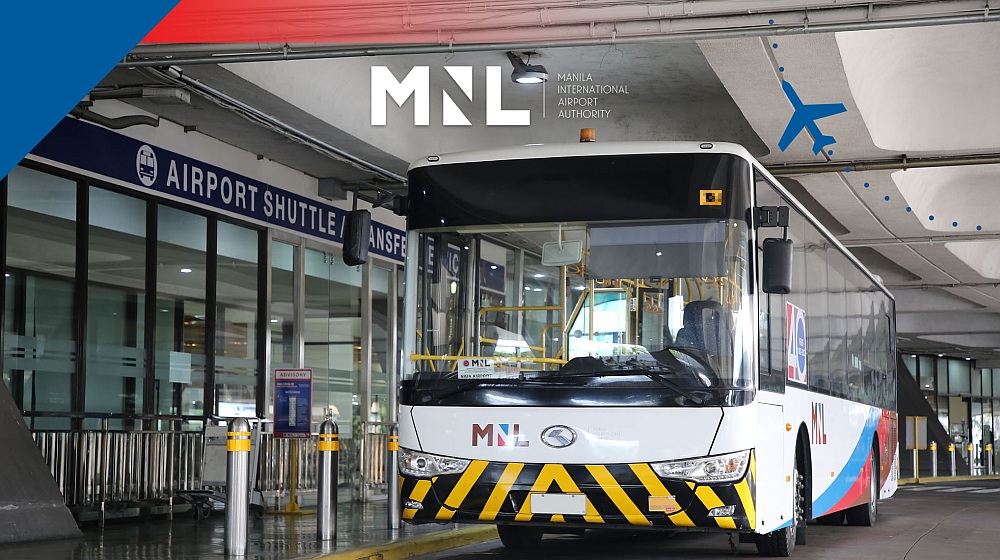
Schedule and stop details (as of 29 March 2022) are available via this link.
Taxis
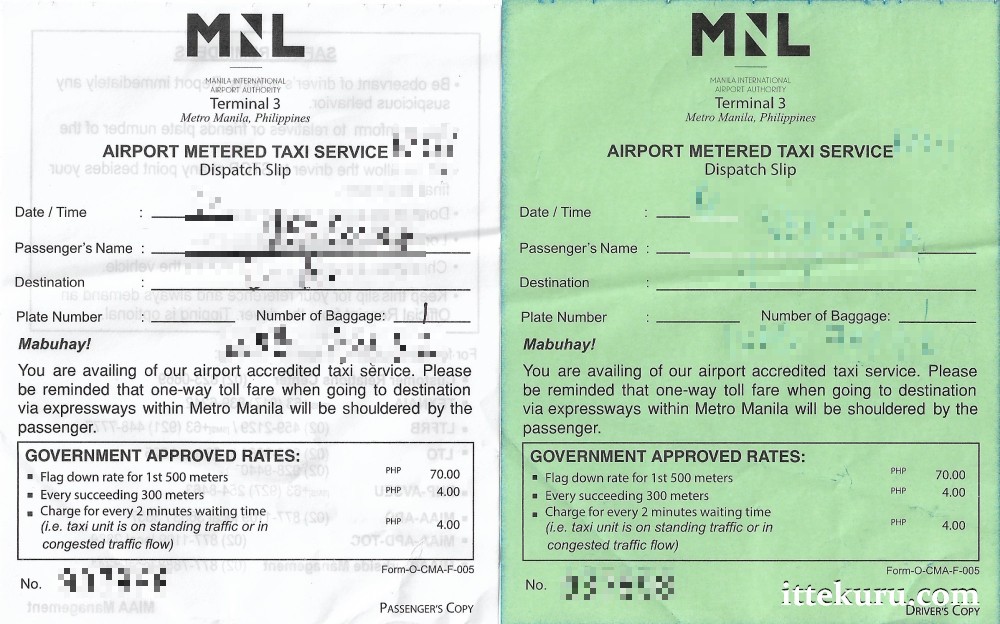
Yellow airport taxis hold special licences to accept passengers at MNL, which subjects them to somewhat more stringent requirements as to operating condition and other criteria. The minimum “flagdown” rate is PHP 75.00 (source) for the first 500 metres. PHP 4.00 is added for every succeeding 300 metres, plus PHP 4.00 per 2 minutes of waiting time.
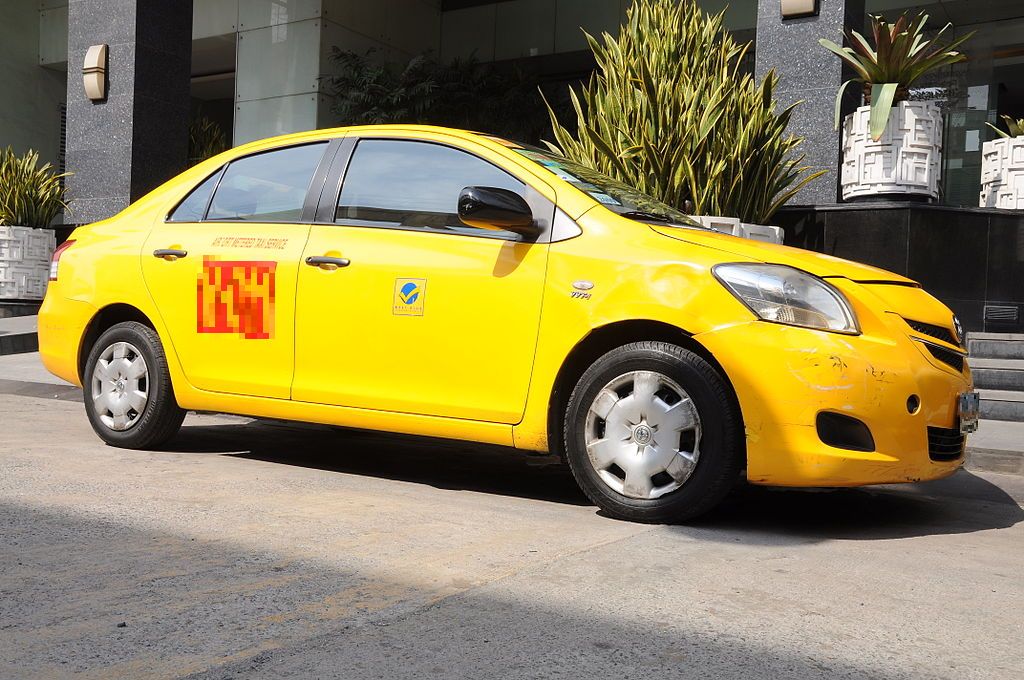
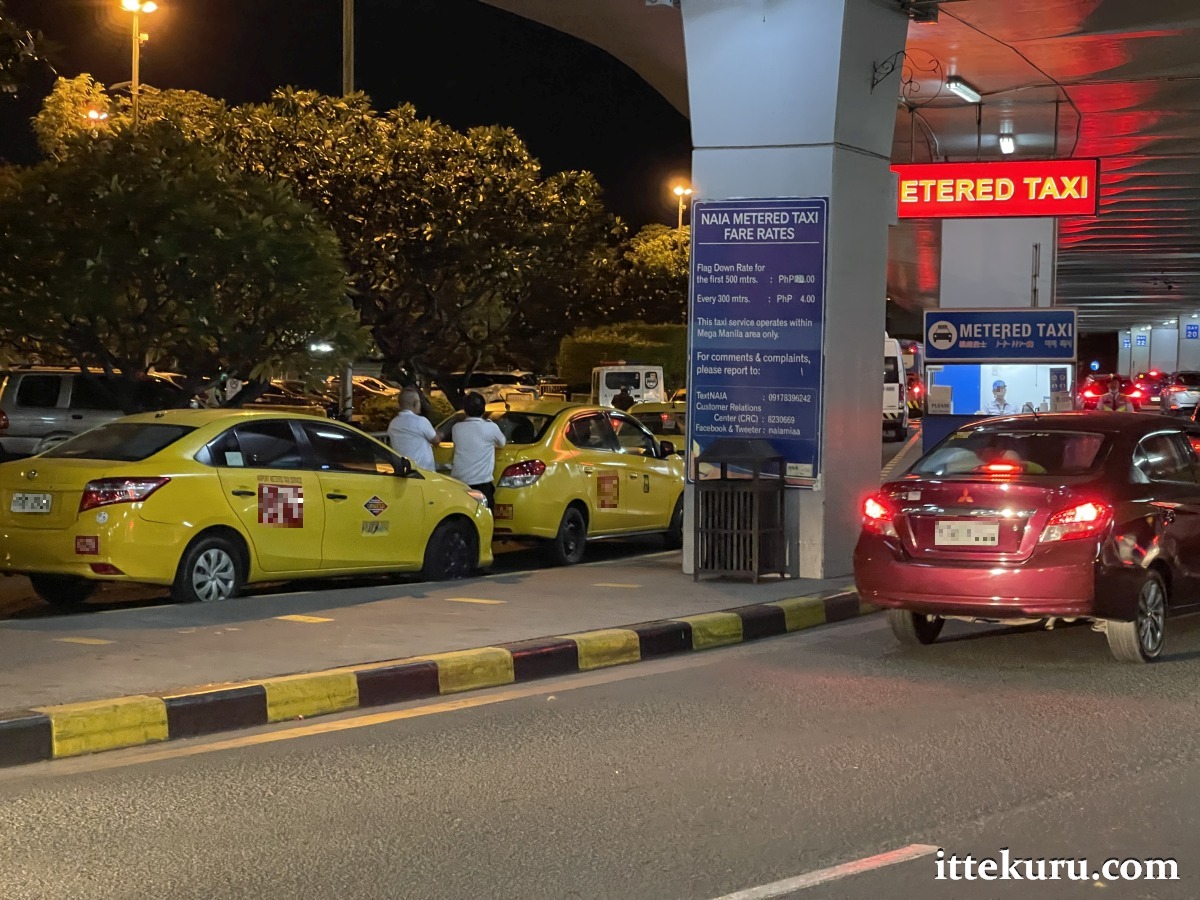
A staff member will note down the vehicle’s registration number on a dispatch slip, which will be handed to you before boarding. Retain one copy as you’ll need the taxi’s details if it should become necessary to file a complaint, retrieve articles left behind or raise any other concerns after the journey. (Note that the base fare printed on the older forms below is no longer current.)
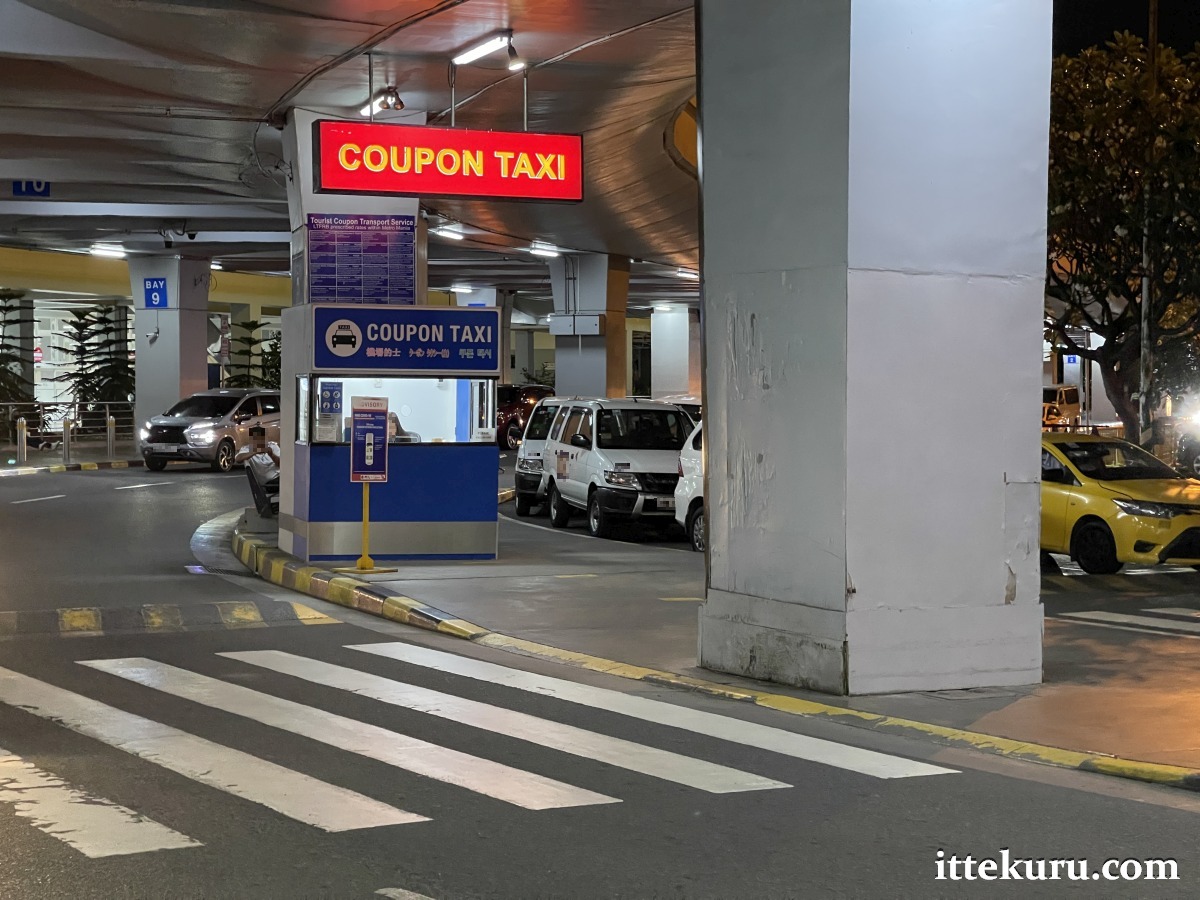
Fixed-rate/coupon taxis will transport you from MNL at a predetermined price (varies by destination). Although the flat rates may work out to be more expensive than metered fares, one advantage of the coupon taxis is that many of them are larger-capacity vehicles than typical sedan taxis.
Ordinary white taxis are widely used throughout Greater Manila, including the airport. Flagdown starts at PHP 45.00 and the fare increases during the journey (PHP 2.00 per minute of travel, PHP 13.50 per kilometre – source).
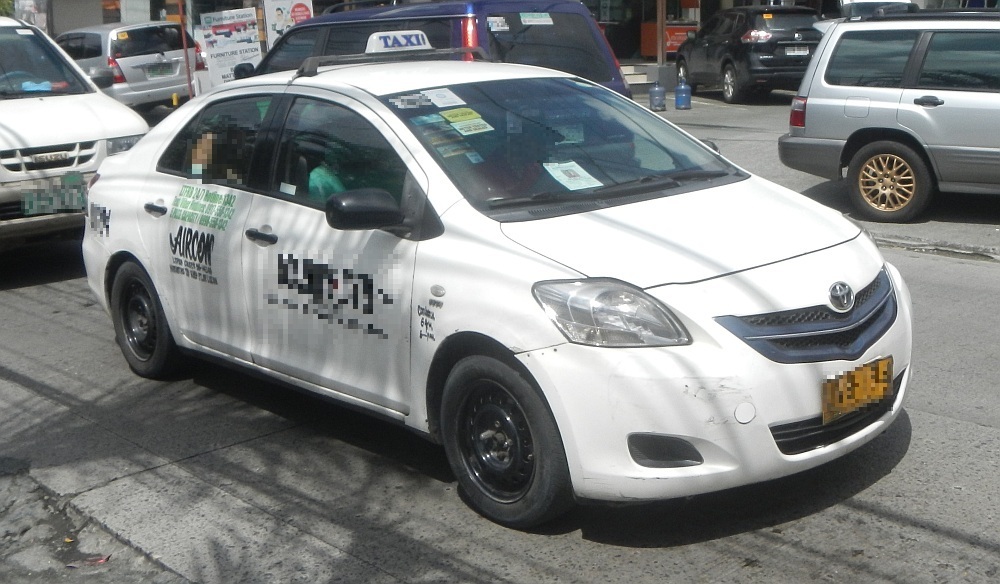
Travellers boarding white taxis from an official stand at the airport may be issued dispatch slips similar to the ones used for yellow cabs. The form used is slightly different (picture here), but it serves the same purpose; i.e., as a record of the vehicle’s information in case complaints or other concerns need to be addressed later.
Whichever type you choose, you should only arrange transport at one of the signposted taxi ranks. Ignore the touts standing outside the terminal exits, even if they’re wearing official-looking vests or IDs (which may well be fake).
If you’ve boarded a metered taxi – be it yellow or white – you should always insist on the metre being used. You should likewise check that the metre is only turned on when you board. If it had been left running beforehand (whether fraudulently or by honest mistake), your final bill will be higher than it should have been. Pricing scams are rife amongst taxis of any description, with some unscrupulous drivers presenting fake (but official-looking) “fare cards” with exorbitant tariffs, or trying to negotiate inflated fares whilst keeping their metres turned off.
Ride-hailing services (TNVS)
Transport network vehicle services (TNVS) are regulated much like taxis, with similar fare structures. The official price matrix approved on 16 September 2022 (source) allows operators to collect PHP 45.00 flagdown, PHP 15.00 per kilometre travelled, and PHP 2.00 per minute travelled if the vehicle is a car/sedan. (Different rates apply to larger or smaller vehicles.) The key difference versus taxis is the “surge pricing” permitted to TNVSs, where the variable charge may increase to as much as twice the basic rates depending on demand. This is meant to ensure that enough TNVS drivers are attracted into the market at peak hours.
Several apps are available for summoning transportation services in the Philippines. Grab is the dominant player, having extinguished its key competition by absorbing Uber’s local operations.
The Grab app offers the following options:
- GrabCar – This will summon a privately operated hire car, with the cost calculated and displayed right on the app before the trip starts. You’ll pay the price shown (plus tolls if using motorways) since these cars aren’t fitted with metres. You might also see an option to call for a larger or premium-class vehicle, which will cost more than the default sedans.
- GrabTaxi – This will hail an ordinary white taxi. An estimated fare range will be displayed on the app, but what you’ll actually pay is whatever the metre reads out at the end of the trip (plus tolls, if any) and a booking fee. As with any taxi, make sure the driver triggers the metre when your journey starts and only after you board.
Hotel shuttles and pick-ups
Some hotels offer complimentary shuttles or paid airport transfers. Check directly with your accommodation provider for availability.
Pandemic-Related Measures
All major pandemic-era directives have now been lifted. Public transport operates at full capacity. Disease-management protocols – such as mask wearing and social distancing – are no longer enforced except in limited settings (such as healthcare facilities).
Like what you’re reading? Buy me a coffee!

 Within striking distance
8 thoughts on “Airport Guide: Accessing Ninoy Aquino International Airport (MNL) by Road”